As an Amazon Associate, we earn from qualifying purchases. Some links on this site are affiliate links at no extra cost to you. Our recommendations are based on thorough research and editorial judgment.


Agility Drills for Pickleball Players

Premium agility training equipment arranged on pristine white backdrop. Professional studio setup features ladder drills, speed cones in vibrant orange and yellow, resistance bands, and agility hurdles. Each piece strategically positioned to showcase functionality and quality. Commercial-grade lighting creates subtle shadows that add depth while maintaining clean, minimalist aesthetic. Sharp focus captures texture details of non-slip ladder rungs and durable cone materials. Color-coordinated equipment in bold pickleball brand colors pops against the white surface. Professional e-commerce presentation perfect for sports catalogs, demonstrating essential tools for improving court movement and footwork speed.
# Agility Drills for Pickleball Players
Agility drills are essential for pickleball players to improve speed and coordination. Ladder drills enhance footwork, while side-to-side shuffles develop lateral movement skills. Incorporating cone drills can facilitate quick directional changes, boosting overall agility. Reaction ball exercises refine hand-eye coordination and response time. Integrating core stability workouts helps with effective movement and shot execution. Emphasizing measurable goals can track progress effectively. Understanding these drills lays the foundation for enhanced performance on the court. More insights await as you explore further.
Key Takeaways
- Incorporate ladder drills to enhance speed, coordination, and agility, focusing on maintaining a low center of gravity and proper foot placement.
- Practice side-to-side shuffle drills to improve lateral movement and court coverage while keeping your paddle ready for quick shots.
- Use cone and modified pro agility drills to develop quick directional changes and muscle memory with focused sets and repetitions.
- Integrate reaction ball training to enhance hand-eye coordination and quick reflexes, simulating real-game scenarios for improved accuracy.
- Focus on core stability and breathwork to support efficient movement and shot execution, reducing injury risk during play.
Ladder Drills for Enhanced Footwork
Ladder drills offer a proven method for pickleball players looking to enhance their footwork considerably. These exercises improve agility, speed, and coordination, helping players react quickly to on-court demands. By incorporating ladder drill progressions, athletes can build essential footwork mechanics while gradually increasing complexity. Start with simpler drills like the standard step-in, then advance to challenging movements like single-leg hops. Precision is vital; maintain a low center of gravity and keep your eyes forward. Aim for durations of 20 to 60 seconds per drill, allowing 15 to 30 seconds of rest between sets. With regular practice, players can expect increased first-step quickness, better reaction times, and reduced foot placement errors during games. To support these demanding movements, players should wear shoes with quality traction and stability features that are crucial for executing quick lateral movements safely and effectively on the court.
Recommended Products


Durability and Strenuous Training Support: our rubber training ladder for footwork is made with quality rubber, providing durability; The material ensures dependability during your high intensity workouts; No need to worry about longevity or reliability, it's built to last!

Adjustable midfoot belt
Side-to-Side Shuffle Drills
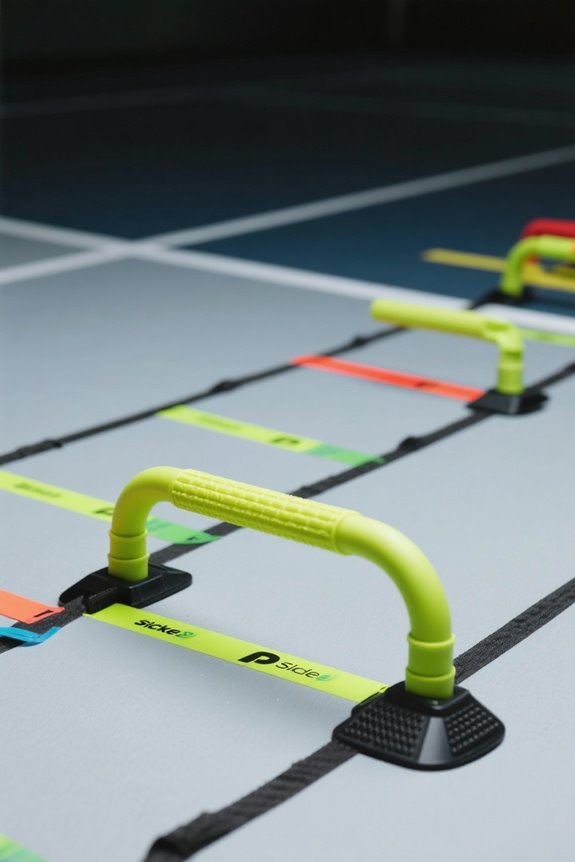
Mastering side-to-side shuffle drills can greatly enhance a pickleball player’s agility on the court. These shuffling techniques are essential for maintaining court coverage, especially at the kitchen line. Players should focus on using small, quick steps with knees bent to improve movement efficiency and balance. Keeping the paddle up and in front guarantees readiness for shots, while avoiding excessive lunging that can lead to loss of control. To practice, players can shuffle laterally along the non-volley zone line, which cultivates effective shot execution. Consistent practice of these drills will enhance court positioning and reaction time, ultimately leading to better performance during competitive play. Using a lightweight paddle design between 6 to 8 ounces can further improve maneuverability during these quick lateral movements. Embrace these techniques for a more dynamic presence on the pickleball court.
Recommended Products

FAMILY-OWNED: At Selkirk, we are committed to fueling the pickleball obsession found within every player. Through uncompromising quality and a never-satisfied drive for innovation, we serve players around the world from beginners to pros.

UNRIVALED STRENGTH: Constructed using a double thermoforming process designed to maximize the integrity of the paddle by enhancing the structure — not once, but twice — which increases the strength of the unibody design and helps to reduce vibration

4th Generation Tech: The CRBN TruFoam Waves professional pickleball paddle is the bold new evolution of foam-core performance. Built with the same 100% TruFoam technology that made Genesis a game-changer, Waves takes things further with an all-new core engineered for maximum power.
Cone and Modified Pro Agility Drills
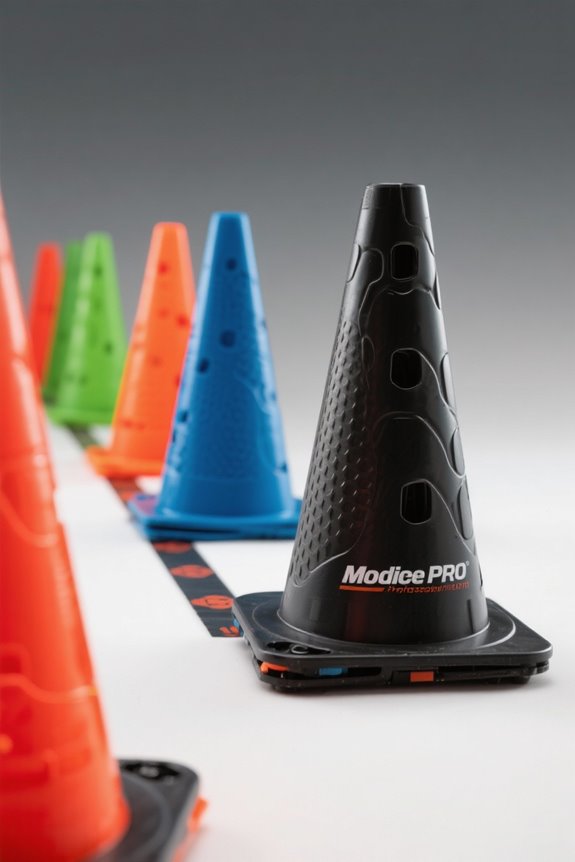
Building on the foundation of side-to-side shuffle drills, incorporating cone and modified pro agility drills can further refine your agility on the pickleball court. The modified pro agility drill reduces cone spacing to 3.5 yards, creating a 7-yard course better suited for smaller courts. This adaptation encourages quick lateral movements in an “L” shape, minimizing excessive steps. It is recommended to perform 2-3 sets per side with 2-3 repetitions each to build speed and coordination. Additionally, traditional cone drills, such as the L-Drill, emphasize quick directional changes and acceleration. Adjusting cone spacing during drill progression increases training intensity, enhancing muscle memory and footwork agility essential for reacting efficiently during intense rallies. Just as selecting the right equipment enhances performance, developing agility through targeted drills complements the benefits of using a medium-weight paddle that balances power and control during quick directional changes.
Recommended Products


Quick And Easy Setup: Transform any space into a pickleball court with our pickleball court marking stencil kit. It's perfect for driveways, home gyms, parks, and indoor facilities. Our versatile court marking kit ensures a professional-quality template for court markings wherever you play. It takes 15-20 minutes to lay out the cardboard stencil kit, then another 15-20 minutes to paint. Let dry for 30 minutes and your pickleball court is ready to play on.
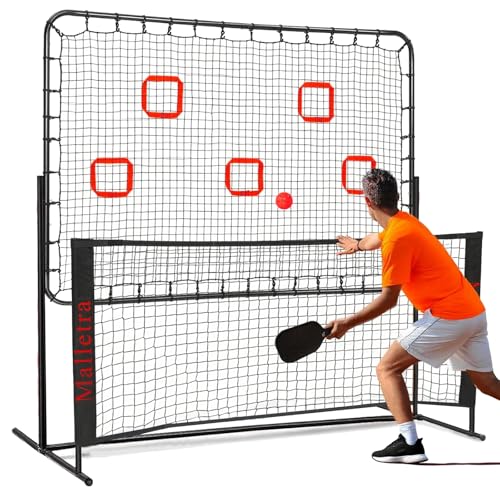
Master Your Solo Practice: Perfect for players at all levels, this pickleball rebounder trainer simulates real-game returns, allowing you to practice serves, volleys, and dinks anytime, anywhere – no partner needed!At the same time, our training net is large enough (size:183*183cm/72.04*72.04inch), and we are equipped with two sets of nets, which can also be used for two person training!
Reaction Ball and Reflex Training
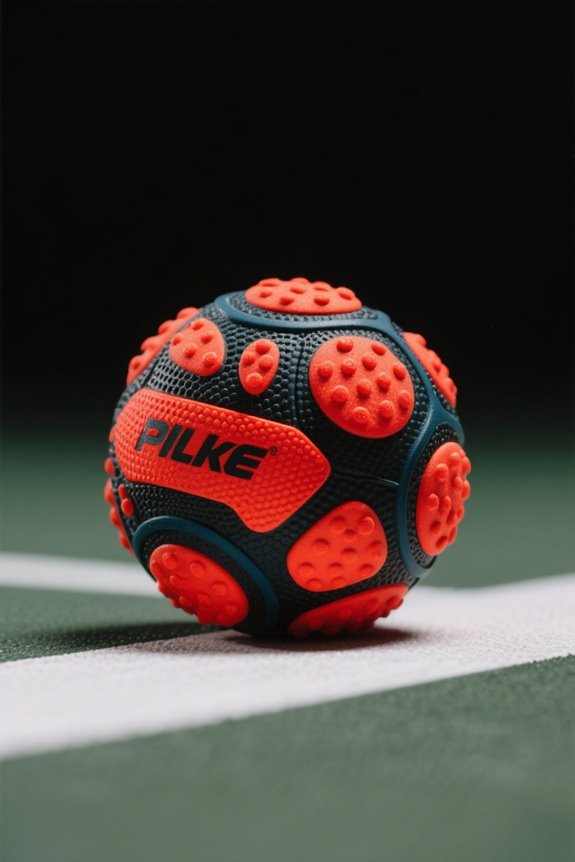
Enhancing reflexes is critical for pickleball players aiming to elevate their game. Reaction ball exercises play an essential role in refining hand-eye coordination and quick responses. Utilizing specialized balls, players can engage in speed drills that heighten agility and precision. Reflex training techniques, such as wall ball exercises and shadow drills, mimic real game scenarios, improving reaction time and muscle memory. Practice rebounders with marked zones provide realistic ball returns that further develop reflexes and targeting accuracy. Regular practice, ideally 2-3 times a week under professional guidance, guarantees consistent improvement. Tools like miniature paddles and balls enhance targeted training, while partnership drills simulate competitive situations. By focusing on these methods, players not only improve their quickness at the net but also gain a competitive edge against faster opponents.
Recommended Products
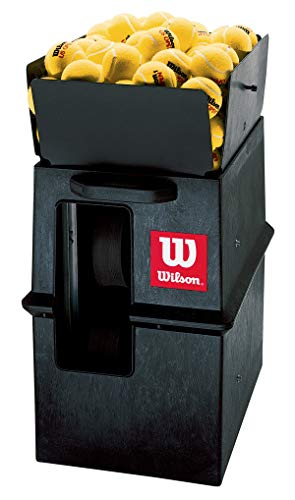
WILSON SPORTS, the #1 name in tennis, in partnership with Sports Tutor, the #1 tennis machine manufacturer in the U.S. and Worldwide, bring you the quality and performance you expect from Wilson.
WILSON SPORTS, the #1 name in tennis, in partnership with Sports Tutor, the #1 tennis machine manufacturer in the U.S. and Worldwide, bring you the quality and performance you expect from Wilson.

📱【PUSUN App Drill Control】:Scan the QR code on the machine to download and use the PUSUN App, compatible with both iOS and Android devices. Use the App to adjust speed, feed interval, spin, height, landing points, and training modes. Practice dinks, volleys, drives, cross-court shots, deep returns, and random feeds with this automatic pickleball launcher.
Multidirectional Drills: T-Drill and Zigzag Movements
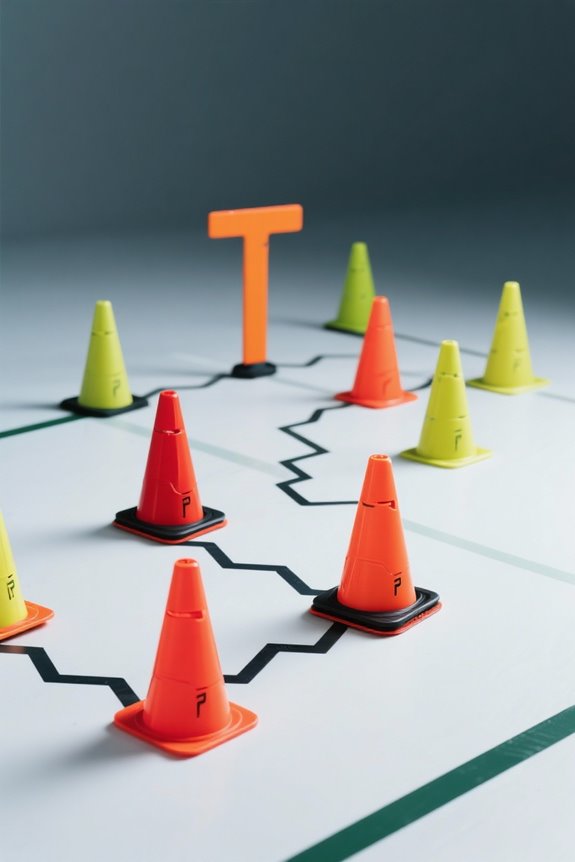
Although pickleball players often focus on racket skills, incorporating multidirectional drills, such as the T-drill and zigzag movements, is equally important for overall performance. The T-drill enhances acceleration and lateral quickness, essential for reaching balls from various angles. Mastering T drill execution techniques, like maintaining an athletic stance, enables quicker direction changes. Zigzag pattern benefits include improved dynamic balance and coordination, helping players track fast balls effectively. Both drills build muscle memory and contribute to injury prevention by strengthening key muscles used in sudden movements. Players who regularly practice these drills often see increased court coverage speed and improved consistency, positively impacting their overall game strategy and performance during competitive matches. When practicing these agility drills outdoors, using high visibility colors on equipment helps players maintain better focus and tracking during sunny conditions.
Recommended Products

Heavier, Thicker, Stronger: Finally, heavier, thicker, and stronger agility cones that won't tip over or slide around. LVL10 Sports Pro practice cones are made of thick and flexible PVC vinyl that's 200% thicker than flimsy, brittle, and small plastic cones from the competition.

Durable Construction: Made from tough PVC plastic, these training cones hold shape in all conditions, ideal for soccer, football, basketball, and more. Perfect for sports drills and driving practice.

Adjustiable hurdle heights: The cross and vertical poles of the hurdle are connected by a roating clamp that you can adjust the position of the clamp on the pole to achieve the adjustment of the height of the hurdle.
Core Stability and Breathwork Integration
Core stability plays a vital role in pickleball performance, acting as the foundation for movement efficiency and shot execution. This stability helps players maintain balance during quick lateral movements and sudden pivots, reducing the risk of injury and enhancing shot power. Incorporating breath patterns into core stability techniques can further boost performance. For example, practicing diaphragmatic breathing during exercises guarantees deeper core engagement. Inhale through the nose when lowering your body and exhale fully as you lift. Utilize exercises like planks and Russian twists, integrating breath holds at peak contractions to activate deep core muscles. By synchronizing breath with movements, you can improve your agility on the court and enhance your overall endurance during long matches. Just as proper footwear with arch support helps distribute weight evenly and reduce strain during athletic activities, maintaining core stability ensures balanced force distribution throughout your body during intense pickleball rallies.
Importance of Agility in Pickleball
Agility often proves to be a game-changer in pickleball. Successful players rely on their ability to swiftly change directions, enhancing court coverage during fast-paced rallies. Quick reflexes improve shot return timing, particularly around the net where exchanges intensify. Moreover, agility contributes to faster recovery post-shot, ensuring readiness for the next play. This capability allows for energy conservation during prolonged matches, while heightened reaction times lead to reduced errors. Additionally, good balance and stability afforded by agility minimize injury risks, promoting injury awareness among players. Protecting vulnerable joints like ankles with adjustable support braces can further reduce the risk of sprains during quick lateral movements on the court. Mental resilience is also fortified as agility training helps anticipate opponents’ moves, thereby fostering adaptability. Ultimately, the importance of agility in pickleball extends beyond performance, impacting overall health and longevity in the sport.
Tips for Maximizing Drill Effectiveness
Maximizing the effectiveness of agility drills in pickleball requires a structured approach that combines technique with purposeful practice. Incorporate various drill variations to target adaptability and precision. Start by mastering slower movements to guarantee proper footwork mechanics, which is essential for injury prevention. Gradually progress to increased speed and complexity while keeping safety in mind. Use focused intervals, like 60 seconds of activity followed by 30 seconds of rest, to build endurance without fatigue. Incorporate sprints and multi-directional drills to mimic game scenarios effectively. Tracking performance metrics, such as accuracy and reaction time, will help measure improvement and inform adjustments. Just as tennis players benefit from equipment that enhances their court coverage, pickleball players should consider how lightweight design in their paddle selection can improve maneuverability during rapid directional changes. Regularly monitoring your progress promotes continual development and helps you avoid plateaus in agility training.
Frequently Asked Questions
How Often Should I Practice Agility Drills per Week?
Practicing agility drills two to three times per week enhances agility benefits greatly. Training consistency plays an essential role in improving overall performance, ensuring that individuals develop necessary skills effectively over time in their routines.
What Is the Ideal Duration for Each Agility Drill Session?
The ideal duration for each agility drill session typically ranges from 15 to 30 minutes, focusing on short, high-intensity bursts. Best session length balances drill effectiveness with recovery, ensuring consistent progress without overtraining or fatigue.
Can Agility Drills Be Adapted for Beginners?
Yes, agility drills can be adapted for beginners through beginner techniques and adaptable exercises. Modifications include reduced intensity, slower speeds, and simplified movements to prioritize foundational skills while ensuring safety and proper form during practice.
What Type of Footwear Is Best for Agility Training?
The ideal footwear for agility training resembles a dancer’s ballet slipper, designed for quick, fluid movement. Shoes should emphasize durable tread patterns and supportive features, ensuring maximum grip and stability for rapid direction changes during workouts.
How Do I Prevent Injuries During Agility Exercises?
To prevent injuries during agility exercises, one should incorporate warm-up exercises, utilize rest intervals between drills, guarantee proper technique, and gradually increase intensity, allowing the body to adapt and reduce the risk of overexertion.


