As an Amazon Associate, we earn from qualifying purchases. Some links on this site are affiliate links at no extra cost to you. Our recommendations are based on thorough research and editorial judgment.


Famous Tennis Rivalries Throughout History

Tennis has witnessed legendary rivalries that transcended sport, captivating audiences worldwide. Björn Borg vs. John McEnroe epitomized contrasting styles—ice-cool precision versus fiery passion. The fierce battles between Chris Evert and Martina Navratilova dominated women’s tennis throughout the 1980s. Roger Federer, Rafael Nadal, and Novak Djokovic created the greatest era in men’s tennis, their epic encounters redefining excellence. Steffi Graf and Monica Seles engaged in intense competition until tragedy struck. Jimmy Connors and Ivan Lendl, Pete Sampras and Andre Agassi—each rivalry brought drama, skill, and unforgettable moments that elevated tennis into a global phenomenon, inspiring generations of players and fans.
# Famous Tennis Rivalries Throughout History
Tennis history is rich with famous rivalries that have shaped the sport. Bjorn Borg and John McEnroe showcased contrasting styles at Wimbledon, while Novak Djokovic and Rafael Nadal exemplified endurance and strategy in their epic matches. Roger Federer and Nadal clashed over playing styles with Federer’s elegance against Nadal’s relentless defense. The emotional intensity of McEnroe marked a distinct era, alongside fierce competitions like Serena and Venus Williams. Each rivalry contributes to a narrative that continues to evolve over time. Discover more about these memorable encounters.
Key Takeaways
- Bjorn Borg vs. John McEnroe redefined tennis with contrasting styles, shaping performances and sportsmanship, particularly during their 1980 Wimbledon final.
- Novak Djokovic and Rafael Nadal’s enduring rivalry is marked by strategic depth and physical demands, with Djokovic slightly ahead in five-set matches.
- Roger Federer and Rafael Nadal showcase opposing styles, with Nadal leading their head-to-head record and excelling on clay courts.
- Pete Sampras and Andre Agassi’s rivalry captivated the 1990s, highlighted by Sampras’s powerful serve and Agassi’s remarkable resilience and return skills.
- Serena and Venus Williams’ sibling rivalry features compelling matches, significant Grand Slam clashes, and a shared achievement of ranking No. 1 and No. 2.
Bjorn Borg Vs John Mcenroe: the Fire-Ice Rivalry
When examining the legendary rivalry between Bjorn Borg and John McEnroe, one quickly recognizes how their contrasting styles and personalities captivated tennis fans worldwide. Borg’s consistency on the court was unmatched, showcasing relentless baseline play and mental toughness. He dominated Wimbledon, winning five consecutive titles from 1976 to 1980. In stark contrast, McEnroe’s temperament fueled his aggressive serve-and-volley style, marked by emotional outbursts and intense competitiveness. Their memorable encounters, including the celebrated 1980 Wimbledon final, highlighted this dichotomy—Borg’s calm versus McEnroe’s fiery passion. The evolution of their rivalry symbolized a shift in tennis dynamics, pushing boundaries not just in performance but also in sportsmanship. Together, they redefined the sport, enhancing its appeal to a broader audience. Serious players today who wish to emulate these legends’ dedication require equipment that matches their commitment, including bags with thermal protection technology to safeguard their racquets during travel to tournaments.
Novak Djokovic Vs Rafael Nadal: Endurance and Strategy

The rivalry between Novak Djokovic and Rafael Nadal stands as one of the most remarkable in tennis history, characterized by endurance and strategic depth. Their matches often showcase incredible rally endurance, pushing both athletes to their physical limits. Particularly, Djokovic has a slight edge in five-set encounters, leading 2–1, while displaying exceptional flexibility and defense. Nadal, revered for his heavy topspin, relies on aggressive court coverage, especially on clay. Each player exhibits strategic adaptability; Djokovic employs precision to counter Nadal’s relentless aggression. Their contests frequently exceed three hours, illustrating the demands of their rivalry. This remarkable interplay of endurance and strategy makes their matches thrilling, as both champions continuously adjust tactics based on opponent and surface. The intense lateral movements and quick directional changes in their matches demand footwear with excellent cushioning and stability features to maintain peak performance throughout extended play.
Roger Federer Vs Rafael Nadal: a Clash of Styles

One of the most enthralling rivalries in tennis involves Roger Federer and Rafael Nadal, showcasing a remarkable clash of styles. Their playing strategies reflect this contrast; Federer’s elegant, all-court game emphasizes attacking play, while Nadal’s relentless defense and heavy topspin dominate from the baseline. Match statistics reveal Nadal leads their head-to-head 24-16, particularly excelling on clay courts with a 14-2 advantage. Conversely, Federer has triumphed on grass and hard courts, holding a 3-1 and 8-6 edge, respectively. Both players exhibit impressive career achievements, with Nadal claiming 22 Grand Slam titles to Federer’s 20. Their unique styles highlighted by statistics bring depth to this iconic rivalry, enthralling fans and analysts alike throughout their encounters. Nadal’s baseline dominance is enhanced by his use of racquets with open string patterns that generate the heavy topspin characteristic of his aggressive groundstrokes.
Pete Sampras Vs Andre Agassi: the 1990S Icons
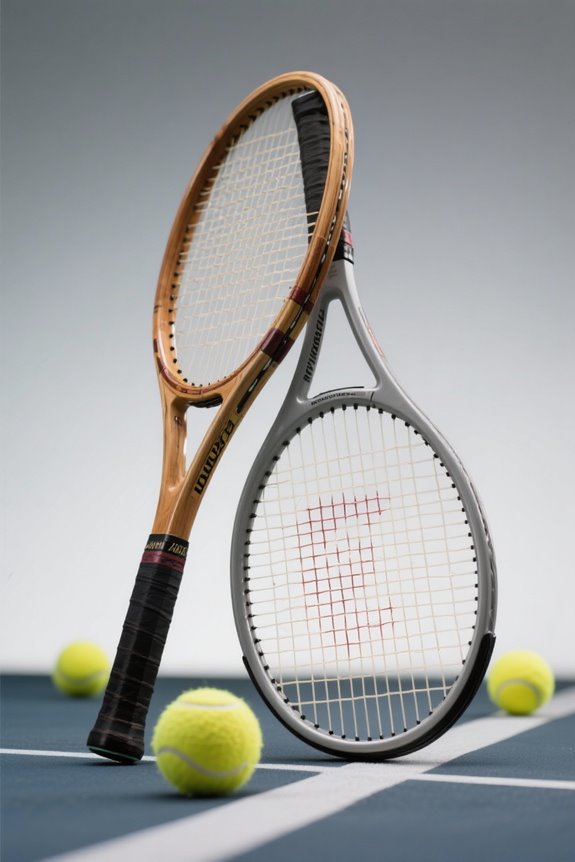
In the domain of 1990s tennis, the rivalry between Pete Sampras and Andre Agassi stands out as a defining chapter. Sampras’s dominance was evident as he led their head-to-head matches 20-14, winning 10 of 15 Grand Slam encounters. His powerful serves and aggressive all-court game set a high standard. Conversely, Agassi showcased remarkable resilience, cleverly countering Sampras’s serve with his exceptional return skills. This rivalry, spanning 13 years and 30 matches, captivated fans and elevated tennis’s popularity. Remarkably, Agassi triumphed in the 1990 US Open, marking a key moment in their competition. Recreational players inspired by these legends can enhance their own game by selecting equipment with features like oversized head sizes that provide a larger sweet spot for improved forgiveness and control. Ultimately, both players left lasting legacies, inspiring a generation and considerably shaping the global view of tennis during the 1990s.
Serena Williams Vs Venus Williams: a Sisterly Showdown

A remarkable chapter in tennis history unfolds with the rivalry between Serena Williams and Venus Williams. This sibling dynamic is defined by their competitive achievements, leading to an electrifying series of matches. Their head-to-head record stands at 19–12 in favor of Serena, with both sisters clashing 16 times in Grand Slam events. Their first encounter in 1998 set the stage for an intense rivalry. Significantly, they became the first sisters ranked No. 1 and No. 2 in 2002. With nine finals contested, Serena holds a 7–2 advantage, while their doubles success complements their singles rivalry, highlighted by 14 Grand Slam titles together. Like athletes in other racquet sports who must select equipment carefully—such as pickleball players choosing paddles with proper weight and balance for optimal maneuverability—the Williams sisters have meticulously refined their racquet choices throughout their careers. Their journey is both compelling and historic, marking them as two of tennis’s greatest competitors.
Martina Navratilova Vs Chris Evert: a Historic Rivalry
The Evert–Navratilova rivalry stands as a defining moment in tennis history, enthralling fans and experts alike with its intensity and skill. Spanning from 1973 to 1988, they faced each other 80 times, including 60 finals, revealing complex rivalry dynamics. Navratilova edged ahead in their head-to-head record at 43–37, with a significant 36–24 advantage in finals. Their contrasting styles—Evert’s precision versus Navratilova’s aggressive net play—provided fascinating matchups marked by emotional intensity. Together, they held the WTA world No. 1 ranking for 592 of the first 615 weeks from 1975–1987. The legacy impact of their competition not only elevated women’s tennis but inspired future generations of athletes, establishing a benchmark for excellence in the sport. Much like how today’s serious pickleball players rely on specialized equipment bags to organize and protect their gear, professional tennis players of that era needed quality equipment management to maintain their competitive edge during grueling tournament schedules.
Chris Evert Vs Hana Mandlikova: Dominance and Rivalry
Dominance and rivalry marked the intense encounters between Chris Evert and Hana Mandlikova, two iconic figures in women’s tennis. Evert led their head-to-head record 10–5, showcasing her resilience through precise baseline play. Her victories included a commanding 6–1, 6–2 win in the 1984 Wimbledon semifinals. Conversely, Mandlikova’s unpredictability often disrupted Evert’s rhythm, especially in the 1981 US Open final, where she recorded a remarkable upset. Evert’s strategic lobs and consistency countered Mandlikova’s aggressive serve-and-volley style effectively across various surfaces. Their rivalry thrived during a transformational era, bridging generations while solidifying Evert as a dominant force. Both players relied on proper footwear featuring durable outsoles to maintain their competitive edge during grueling matches on hard court surfaces. Ultimately, their matches underscored the dynamic balance between Evert’s methodical excellence and Mandlikova’s flair for the dramatic.
Kim Clijsters Vs Justine Henin: a Close Contested Battle
Rivalry often fuels the spirit of competition, and the intense encounters between Kim Clijsters and Justine Henin illustrate this perfectly. Their rivalry evolved over many years, featuring 22 historic matches. Henin led their head-to-head record 12–10, aided by a mental edge in later encounters, where she won eight of their last eleven. Each player showcased unique playing styles, with Henin’s finesse contrasting Clijsters’ powerful athleticism. Their Grand Slam encounters, especially in the 2003 French Open finals, heightened national pride in Belgium. Despite personal journeys, including comebacks from retirement, they have greatly impacted tennis. Together, they left a lasting legacy, inspiring future generations through their remarkable competitiveness and sportsmanship in women’s tennis. Much like how modern racquet sports enthusiasts evaluate equipment based on playing style suitability, these two champions adapted their techniques to maximize their natural strengths throughout their storied careers.
Gabriela Sabatini Vs Arantxa Sánchez Vicario: a Competitive Edge
When examining the competitive landscape of women’s tennis in the early 1990s, Gabriela Sabatini and Arantxa Sánchez Vicario stand out as two formidable forces. Their rivalry showcased contrasting styles, with Sabatini’s strengths lying in her powerful serve and strategic net play. Meanwhile, Sánchez Vicario’s strategy centered on exceptional defensive skills and mental resilience. This rivalry was defined by their intense matchups, including significant encounters at the 1991 Australian Open, where Sánchez Vicario upset Sabatini in straight sets. These matches often featured long rallies, revealing the depth of their skills. While Sánchez Vicario frequently gained the upper hand in pivotal moments, Sabatini’s attacking style made her a constant threat, ensuring their matches remained engrossing for fans and analysts alike. Both players relied on racquets with different specifications to complement their playing styles, with considerations like weight and balance playing crucial roles in their ability to execute powerful groundstrokes and maintain control during extended baseline exchanges.
Jimmy Connors Vs Arthur Ashe: Tensions and Legal Disputes
Although both Jimmy Connors and Arthur Ashe were celebrated for their exceptional tennis talents, their relationship was marked by significant tension and contrasting approaches to the game. Competitive tensions between them began in Davis Cup confrontations, where Ashe harbored private resentment toward Connors. Their rivalry included instances of psychological warfare, as Connors criticized Ashe’s playing style, which emphasized tactics over power. In the 1975 Wimbledon Final, Ashe outmaneuvered Connors, exemplifying his strategy with low slices and tactical lobs, winning 6-1, 6-1, 5-7, 6-4. This match highlighted their differing philosophies. Despite public spats and occasional amicable interactions, there were no major legal disputes documented. This complex rivalry shaped the discourse on sportsmanship in tennis and influenced future players’ strategies. The contrasting equipment preferences of players like Connors and Ashe also demonstrated how racquet weight could influence playing style, with lighter racquets promoting maneuverability while heavier ones provided the stability needed for power-based approaches.
The Emotional Intensity of McEnroe
The emotional intensity of John McEnroe defined not only his career but also the landscape of professional tennis during the 1980s. His relentless pursuit of perfectionism pressures led to extraordinary performances, such as his 1984 Wimbledon final victory, where he committed just three unforced errors. However, this intense drive often resulted in emotional volatility, manifesting in on-court outbursts and tantrums that shocked audiences. McEnroe admitted that he used anger to mask deeper feelings, a pattern intertwined with his chronic dissatisfaction. His rivalry with Björn Borg exemplified this cycle, creating emotional highs that sometimes crashed into lows. As media narratives sensationalized his behavior, they failed to capture the profound emotional battle behind his façade of rage and excellence.
The Legacy and Cultural Impact of Tennis Rivalries
Tennis rivalries have profoundly shaped the sport’s legacy, leaving an indelible mark on its history and culture. These fierce contests not only define eras of dominance but also hold great cultural significance. For fans, rivalries create emotional connections that enhance loyalty and engage new audiences. Take the iconic matchups of Borg versus McEnroe or Federer versus Nadal; they captivated viewers and transformed spectatorship. Beyond entertainment, rivalries greatly boost media coverage, driving increased ticket sales and sponsorship revenues. They inspire athletes to elevate their performance by raising the competitive bar. Ultimately, these rivalries symbolize deeper values of perseverance and respect, reflecting societal ideals while uniting communities through shared passion for the game.
Frequently Asked Questions
How Do Rivalries Influence Player Motivation and Performance?
Rivalries ignite motivation dynamics, fueling intense focus and competitive spirit. They drive performance enhancement through strategic adaptations, emotional resilience, and psychological warfare, compelling players to refine skills and elevate their game, thriving under pressure.
What Are the Financial Impacts of Famous Rivalries on Tournaments?
Famous rivalries greatly enhance financial outcomes for tournaments through increased ticket sales and heightened sponsorship revenue, driving demand for premium pricing, merchandise purchases, and substantial investment from corporate sponsors seeking exposure to passionate audiences.
How Do Fans Perceive Rivalries in Tennis Culture?
Fans perceive rivalries in tennis culture through dynamic rivalry perception shaped by athlete reputation and behavior. Fan engagement is influenced by media narratives, personal identification, and social dynamics, creating an intricate web of emotional investment in rivalries.
What Role Does Media Play in Shaping Tennis Rivalries?
The media crafts vivid narratives that transform tennis rivals into icons, painting clashes with vibrant strokes of emotion and tension. Through selective portrayals, they amplify competition’s drama, engaging fans and embedding rivalries into cultural consciousness.
Can Tennis Rivalries Impact a Player’s Mental Health?
Tennis rivalries can considerably impact a player’s mental health by increasing pressure management challenges. Developing emotional resilience becomes essential as players navigate heightened stress and scrutiny, potentially exacerbating mental health issues and creating vulnerabilities.