As an Amazon Associate, we earn from qualifying purchases. Some links on this site are affiliate links at no extra cost to you. Our recommendations are based on thorough research and editorial judgment.

How to Construct a Tennis Point

Master the art of strategic tennis play with precision equipment designed for competitive advantage. This comprehensive guide explores tactical positioning, shot selection, and court coverage fundamentals. Premium rackets, high-performance tennis balls, and professional court markers demonstrate essential elements of point construction—from serve placement to finishing volleys. Learn offensive patterns, defensive recovery positions, and transition game mechanics. Features tournament-grade equipment showcasing baseline rallies, approach shots, and net play strategies. Ideal for intermediate to advanced players seeking to elevate their tactical understanding and dominate matches through intelligent point-building techniques.
# How to Construct a Tennis Point
To construct a tennis point, start by understanding the scoring system from love to 40. Earn points through effective serving and returning, aiming for accuracy and strategy. When both players reach 40, the game enters deuce, where two consecutive points are needed to win. Utilize diverse serve types to exploit your opponent’s weaknesses. Points accumulate into games, progressing to sets and matches. With practice and the right equipment, you can enhance your performance and match play strategy. There’s much more to discover about winning at tennis.
Key Takeaways
- Start your serve by standing behind the baseline and targeting the opponent’s service box with precision for effective rallies.
- Use different serve types, such as topspin or slice, to exploit your opponent’s weaknesses and gain an advantage.
- Maintain proper footwork and positioning to set up for returning serves and creating opportunities to score points.
- Focus on shot placement; hitting to corners or angles can force errors from your opponent, increasing your chances of winning.
- Stay mentally resilient during exchanges; always anticipate the next shot and react quickly to maintain control of the point.
Understanding the Basic Scoring Units in Tennis
In the world of tennis, understanding the basic scoring units is essential for appreciating the game. The term “love” holds significant meaning, representing zero points. This unique term traces its origins to the French word “l’œuf,” meaning “egg,” which symbolizes a lack of points in a game. At the start of each match, players begin at “love,” setting the stage for competition. The scoring progression follows a specific order: from love to 15, then to 30, and finally 40. Winning a game requires four points, necessitating a two-point margin. This structured approach makes tennis scoring distinctive, differing from numeric values in other sports. Just as understanding scoring is crucial, serious players also recognize that selecting USTA approved balls ensures compliance with professional standards during competitive matches. Familiarity with these units enhances the experience and enjoyment of watching or playing tennis.
The Progression of Points: Love to 40

The scoring system in tennis progresses methodically from love to 40, making each point essential for players aiming to win a game. Starting at love, the first point won earns a player a score of 15. This point increment indicates an initial lead. When the second point is won, the score shifts to 30, presenting a clearer advantage. Reaching 40 signifies a player is just one point away from winning the game, which adds pressure on the opponent. Common scoring terminology like “15-love” or “40-30” conveys the relative standing between both players. Movement through these critical increments sets the stage for potential game-winning scenarios, emphasizing the importance of every point played. Proper footwear with shock-absorbing technology helps players maintain performance during these intense scoring sequences on hard court surfaces.
The Concept of Deuce and Advantage
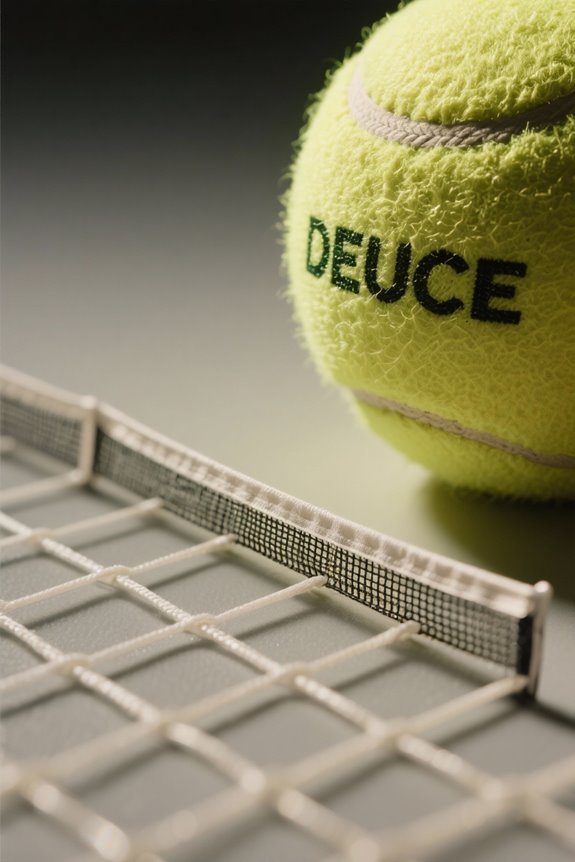
Although often seen as a mere formality in tennis, the concept of deuce and advantage notably impacts gameplay dynamics. At 40-40, players enter what is known as deuce, a state where both competitors must win consecutive points to secure victory. The next point is essential; the winner claims an advantage, labeled “advantage in” for the server and “advantage out” for the opponent. This situation elevates the psychological pressure considerably, affecting players’ performance and decision-making. The deuce dynamics can lead to intense rallies, with each player employing an advantage strategy to maintain or reclaim their edge. If the player with an advantage loses the next point, the score resets to deuce, underscoring the ever-changing nature of the game. During these extended rallies, players may benefit from wearing knee supports that provide stability and shock absorption to minimize the physical impact of rapid court movements.
Winning a Game: Requirements and Scoring

Winning a game in tennis requires a clear understanding of the scoring system and the specific conditions that must be met. Players must score points in the order of 15, 30, and 40. To win a game outright from 40, a player must claim the next point unless the score reaches deuce. At deuce, two consecutive points are required to secure the game. Scoring variations, like “no-ad” scoring, allow a player to win directly from 40-40 by taking the next point. Understanding these rules is vital for developing effective game strategies. Winning games contributes to the overall set, solidifying your progression toward match victory. Consequently, mastery of this scoring system enhances competitive performance on the court. Just as understanding scoring enhances your tactical approach, selecting the right equipment—such as string tension preferences ranging from 20 to 30 kilograms—can significantly impact your overall performance and comfort during competitive play.
The Role of Service in Points and Games
Serving is a critical aspect of tennis that shapes the dynamics of points and games. The serve sets the tone for rallies, as it determines how opponents respond. Effective players utilize strategic serves, targeting their rivals’ weaknesses. For instance, serving down the middle disrupts their rhythm, while precise placement creates challenging angles. Serve accuracy is essential, as missing the service box can lead to easy points for opponents. Players often experiment with different types of serves, such as topspin and slice, to enhance their effectiveness. Consistently winning service games builds momentum and confidence throughout sets. Remember, a powerful serve not only initiates a rally but can also establish a strong attacking position, shaping your path to victory. Having durable tennis shoes with proper grip and stability ensures you can move explosively during your serve and maintain balance throughout the motion.
Recommended Products

Abrasion resistant mesh with coated microfiber reinforcement band

Honda Collaboration: Official Honda branding adds premium style to advanced protection gear.

The glow perpetuates in the Nike Air Force 1 '07, the B-Ball OG that gives a new twist to what you know best: durable stitched overlays, clean finishes and the perfect amount of flash to make you shine
Alternating Serve Dynamics
A well-structured approach to alternating serve dynamics considerably enhances a player’s ability to dictate points. By varying serve placement, players can keep opponents guessing and disrupt their return strategy. Professional male players often demonstrate higher success rates when targeting the corners, winning 71% of first serve points compared to collegiate players’ 66%. In contrast, female players excel at body serves, particularly during high-pressure situations. Adapting serve direction, as seen with Andy Murray’s effective use of wide serves, can exploit opponent weaknesses and lead to offensive opportunities. Dynamic adjustments in serve placement not only hinder opponents’ rhythm but also enable servers to control the subsequent rally more effectively, ultimately contributing to point mastery in tennis. Just as selecting the right racquet based on head size and weight can optimize your equipment for specific playing styles, tailoring your serve strategy to match your strengths ensures maximum effectiveness on court.
Recommended Products


Points, Games, and Sets: A Cumulative Structure
Tennis operates on a structured scoring system that builds from points to matches, allowing players to navigate the competitive landscape systematically. Each point contributes to winning games, which are the fundamental unit of scoring. When players grasp scoring tactics, they enhance their match strategy considerably. Games are won by accumulating enough points, and the dynamic of game momentum can shift swiftly, influencing player psychology in essential moments. Winning a game, particularly on an opponent’s serve, can energize a player, while losing it may create doubt. Accumulating six games to win a set further adds layers to match play, where tactical execution and mental resilience become paramount. Understanding this cumulative structure is critical for aspiring players looking to improve their performance. Aggressive baseliners who excel at constructing points often rely on equipment with larger sweet spots to maintain consistent power and accuracy throughout extended rallies.
The Tiebreak: When and How It Works
How does a tiebreak change the dynamics of a tight match? When the set score reaches 6-6, the tiebreak is initiated to determine a winner. This intensifies the competition as every point counts even more. Tiebreak rules state that the first player to reach 7 points with a 2-point lead wins the set. Players must adapt their set strategies, with a focus on risk management and shot selection, as they navigate this high-stakes environment. Serving alternates every two points, forcing players to maintain composure. Switching ends every six points adds another layer of strategy, preventing environmental advantages. Mastering the tiebreak can greatly shift the momentum in your favor, making it an essential skill for competitive play. After intense matches, proper maintenance and care of your equipment bag helps ensure your gear stays protected and organized for the next competition.
Recommended Products

Unique tennis rebounder design which supports multiple racket sports including pickleball, padel, squash, racquetball, and table tennis. Perfect for athletes of all levels.

Increase Strength and Conditioning With Each Workout - Up To 300 lbs of Resistance

COMPREHENSIVE TENNIS TRAINING KIT: Curated to maximize the potential of tennis players by enhancing balance, strength, speed, agility, reaction time, and muscle memory. Designed with input from tour-level coaches to deliver professional-grade results, this kit is ideal for anyone looking to improve their game with tennis training equipment and tennis training aids.
Detailed Rules of Serve and Faults
Understanding the detailed rules of serve and faults is essential for any player looking to improve their game. A proper serve involves specific mechanics, such as standing behind the baseline and delivering the ball diagonally into the opponent’s service box. Once the serve motion begins, it must be continuous. Players face various fault types; a fault is called if the serve fails to land in the correct area. Significantly, a double fault results in losing the point. If a serve hits the net but lands correctly, it is a let and replayed. Both singles and doubles have unique serving rules, which affect gameplay dynamics. For practice sessions focused on developing consistent serve mechanics, pressureless tennis balls offer reliable bounce characteristics that maintain performance throughout extended training periods. Becoming familiar with these regulations can greatly enhance your performance on the court.
Recommended Products

High-quality tennis balls, ideal for regular training

【SPECIFICATION】Diameter: 2.58 Inches; Bounce Height: About 135cm.

Wilson Triniti Pro Tennis Balls - 72 Balls, Yellow
Match Structure: From Points to Matches
The framework of match structure in tennis is essential for understanding the progression from individual points to entire matches. In tennis, each match begins with points. Those points combine to form games, which in turn, create sets. Players need to win a specific number of sets to claim victory, dictated by match formats. For instance, in best-of-three sets, players must win two sets; in best-of-five, they need three. Set importance cannot be understated, as each set requires winning six games with at least a two-game lead. The match’s progression, from points to games to sets, highlights a player’s abilities and strategies, paved with moments of intense competition. Understanding this structure prepares you for the challenges of the sport. As you develop your competitive skills, selecting equipment with the right weight and balance can significantly impact your ability to execute strategic plays during crucial points.
Frequently Asked Questions
Recommended Products

Unique tennis rebounder design which supports multiple racket sports including pickleball, padel, squash, racquetball, and table tennis. Perfect for athletes of all levels.

Weight: TR40 10.6oz/300g; TR40 Lite 9.7oz/275g ; TR40 Junior 8.4 oz/240g

WRISTBAND PLAYBOOK - Lead your team to victory with the WristCoaches quarterback wristband (10 Pack). Run the offense like a pro while you call deep balls, play-action passes, screens, or go for the RPO. Put defenses on skates as you skillfully execute big plays!
What Is the Significance of “Love” in Tennis Scoring?
What embodies the essence of competition more than “love” scoring in tennis terminology? This term represents zero points, mirroring the sport’s historical roots and reflects both cultural exchange and the game’s amateur spirit.
How Does a Player Recover From a Deuce Situation?
To recover from a deuce situation, a player employs deuce strategies emphasizing mental resilience, maintaining focus, and executing consistent shots, while avoiding distractions. Each point is treated as an independent opportunity to regain control and win.
Can a Player Win a Game Without Winning the Last Point?
Winning a tennis game without the last point is as likely as outsmarting gravity; psychological tactics and match strategy falter under the immutable rule that every game’s conclusion hinges on that final, decisive point.
What Happens if a Server Touches the Net While Serving?
If a server touches the net while serving, it results in a service fault. This net violation leads to the loss of the point, as the server’s action disrupts the normal play.
How Do Weather Conditions Affect Point Construction in Tennis?
Weather conditions dramatically shape point construction in tennis, with temperature effects slowing reflexes, wind impacting shot precision, humidity influencing ball behavior, and court conditions demanding constant player adjustments, transforming a game into a chaotic ballet of unpredictability.