As an Amazon Associate, we earn from qualifying purchases. Some links on this site are affiliate links at no extra cost to you. Our recommendations are based on thorough research and editorial judgment.


Complete Guide to Tennis Scoring System

Professional studio photograph showcasing tennis scoring essentials on pristine white backdrop. Features official tennis scorekeeper’s flip chart, vibrant yellow tennis balls, and electronic scoreboard display arranged in minimalist composition. Premium catalog-style lighting creates soft shadows while highlighting the deep green court lines on official scoring card. Crystal-clear 8k resolution captures every detail of the scoring system components. Centered placement emphasizes the professional-grade equipment used in competitive tennis matches. Commercial photography style perfect for high-end sports retailers and equipment catalogs, demonstrating tournament-standard scoring tools with vivid, true-to-life colors.
# Complete Guide to Tennis Scoring System
The tennis scoring system is straightforward yet intricate. Points progress from love to 15, 30, and 40. Winning a game requires four points, often demanding two consecutive wins from a deuce. Sets consist of multiple games, with a typical win being six games by a two-game margin. Recent rule changes, like the 10-point tiebreak at 6-6 in final sets, reflect evolving competition. Understanding these fundamentals will enhance your tennis experience as you discover more about the game’s intricacies.
Key Takeaways
- Tennis scoring progresses from love (0) to 15, 30, and 40, with winning a game requiring four points and a two-point lead.
- Deuce signifies a 40-40 tie, needing two consecutive points to win the game, while winning grants an advantage.
- Sets are won by securing six games with at least a two-game margin, commonly ending in scores like 6-0 or 7-5.
- Tiebreakers resolve 6-6 ties in sets, with players alternating serves and the first to seven points winning, requiring a two-point lead.
- Recent changes include a 10-point tiebreak for final sets in Grand Slams and a 7-point team format in NCAA Division III.
Understanding Tennis Points
Understanding the intricacies of tennis points is essential for both players and fans alike. The unique progression of points—love, 15, 30, and 40—may seem confusing at first, but it plays a significant role in point accumulation and scoring strategy. Players must win four points to secure a game, which requires careful planning and tactical execution. When the score reaches deuce, a player must win two consecutive points, showcasing the tension and turning moments of a match. Each point won builds towards winning games, sets, and ultimately the match itself. This scoring framework emphasizes the importance of each point, as the accumulation directly influences the match’s outcome, compelling players to devise effective strategies during intense gameplay. Just as players must carefully strategize their scoring approach, advanced players also consider equipment choices like polyester tennis strings to maximize control and spin potential during crucial points.
Basic Scoring Terminology
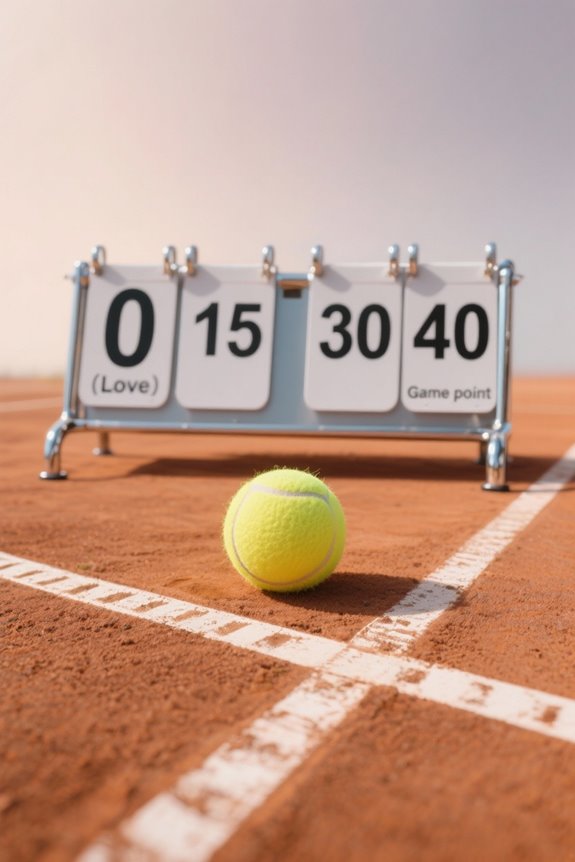
In tennis, specific scoring terminology is essential for both players and spectators. Understanding scoring nuances requires knowing terms like “love,” which means a score of zero, and the point hierarchy consisting of 15, 30, and 40 points. When a score reaches deuce, tied at 40-40, players must win two consecutive points to claim the game. An advantage point, either “Ad in” or “Ad out,” indicates who leads after deuce. Game points are crucial, determining if a player wins the game, while set and match points indicate chances to clinch sets and matches respectively. Familiarity with these terms enhances the experience, allowing a deeper appreciation of the competitive dynamics on the court. Just as understanding scoring is fundamental to playing tennis, selecting the right equipment like a racquet with the appropriate grip size can significantly improve control and comfort during competitive play.
How Games Are Scored
When players engage in tennis, scoring each game follows a distinctive structure that blends simplicity with a few strategic intricacies. Game scoring progresses sequentially from “Love” to 15, 30, and 40, culminating in victory upon winning four points while leading by at least two. This structured approach encourages varied player strategies. When the score reaches deuce, additional tactics come into play to secure that essential two-point lead, although that specific discussion will be reserved for later. The server always announces their score first, creating an organized rhythm that helps spectators follow the game. Each win contributes to a player’s total set score, reinforcing the importance of consistent performance throughout the match. Professional players often carry multiple racquets in specialized tennis bags that can accommodate anywhere from 3 to 9 racquets to ensure they have backup equipment ready for any scoring situation during matches.
Recommended Products
![[YONEX] Tennis Badminton Racket Bag Holds 9 Rackets Scarlet](https://m.media-amazon.com/images/I/41zbMHTq4dL._SL500_.jpg)
Dimensions: 78cm wide x 36cm deep x 36cm high

NEW PRO V3 UPGRADES: This versatile tennis bag now features a mess-free toiletry pocket, dual top handles for easy carrying, a secure hidden pocket, an improved sweat compartment, and stronger metal clips on height-adjustable straps. With expanded space for tennis racket bags and added sleeves for pickleball paddles, it doubles as a pickleball bag too.

Room for a full session: generous multi-compartment storage carries your racquets, shoes and clothes. A ventilated shoe pocket and a secure valuables pocket keep the details in order.
The Deuce Rule Explained
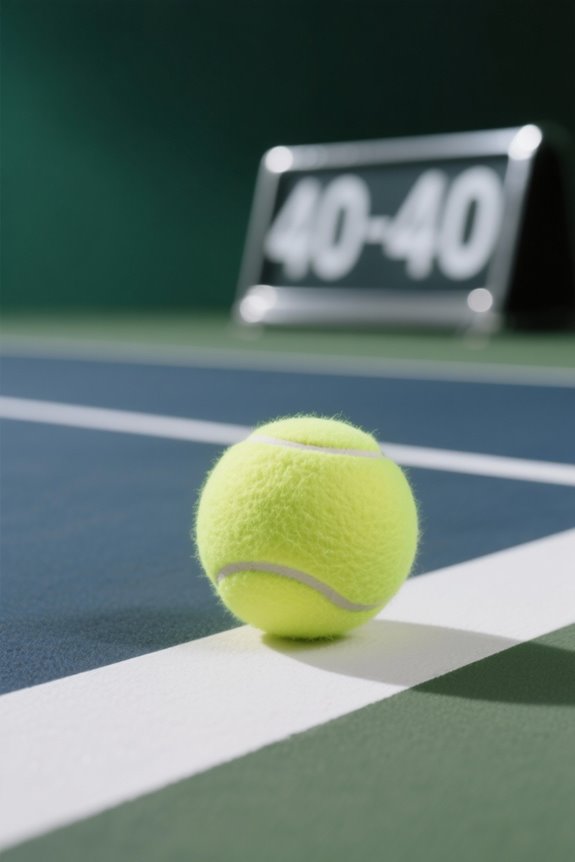
Tennis matches often hinge on the pivotal moments that occur at deuce. This term, originating from the French word “égalité,” signifies a tied score of 40-40. At deuce, one player must win two consecutive points to clinch the game, making deuce dynamics essential in determining match outcomes. As players navigate these high-pressure moments, effective scoring strategies come into play. After reaching deuce, the next point won grants “advantage” to one player. If that player secures the subsequent point, they win the game; otherwise, play returns to deuce. This two-point requirement prevents abrupt conclusions and emphasizes the players’ endurance and tactics. Deuce situations often excite spectators, intensifying the competitive atmosphere throughout the match. During these extended rallies and quick lateral movements, players rely on shoes with advanced cushioning technologies to reduce joint impact and maintain peak performance.
Advantage and Game Point Mechanics
Understanding advantage and game point mechanics is essential for both players and fans of the sport. The advantage point occurs immediately after a deuce, indicating a temporary lead. The player who wins the advantage must secure one more point to win the game. If they lose the next point, the score returns to deuce. This system guarantees a two-point margin, fostering strategic depth. Players often shift their approach during game point pressure, increasing aggression or focus. Successfully transforming an advantage into a game win is critical and often depends on mental composure. Coaches emphasize advantage strategies to help players navigate these high-stakes moments effectively, enhancing their chances of victory in tightly contested matches. Just as competitive players benefit from equipment with precise tension settings to optimize their racket performance, they must also develop the mental precision needed to capitalize on advantage situations.
Serving in Games
Serving in games is a pivotal moment that can set the tone for the entire match. The player who wins the toss generally opts to serve first, a strategic choice affected by external factors like wind direction. Positioning is critical; servers must stand behind the baseline and hit diagonally into the opponent’s service box. Effective serving strategies involve a mix of power and placement. A strong first serve can yield an ace, while a second serve typically demands more caution, ensuring it lands safely. Additionally, utilizing the let serve rule allows players to maintain serve dynamics, ensuring fairness. Understanding how to adjust these variables can greatly influence game outcomes. For players developing their skills, using lightweight rackets can reduce strain and improve serve mechanics during practice sessions. Ultimately, mastering serving techniques is essential for success on the court.
Recommended Products
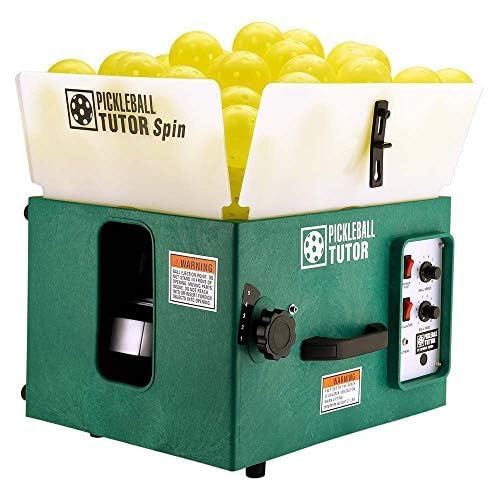
EASY-TO-USE KNOB CONTROLS - No programming or phone app required.

📱【Master the Court: 12 Modes for Every Level】 Frget manual knobs; the PT-Smart is fully App-controlled with 12 drills, including a "Primary" mode to build beginner confidence and AI Drill for custom paths.For advanced players, "Vary Speed" and "Program" modes simulate real match rhythms, allowing you to switch intensity instantly without running back and forth.

Wilson RF 01 Pro Strung Performance Tennis Racket - Grip Size 4-4 1/2", Strung with Sensation 16 Natural at Mid Range Tension
Structure of Tennis Sets
The structure of a tennis set serves as the backbone for match progression, shaping the competitive landscape on the court. Typically, a set consists of consecutive games where a player must win six games with a two-game lead to secure victory. In high-pressure moments, tiebreaks can decide a close set, often recorded as 7–6. Various set variations, like the 8-game pro set, aim to enhance play and reduce match duration, particularly in recreational contexts. Understanding this structure fosters effective match strategies, allowing players to adapt and plan accordingly. Ultimately, mastering set compositions not only enhances competitiveness but also elevates both the enjoyment and drama inherent in the sport of tennis. Players seeking optimal performance should ensure they have proper equipment, including tennis shoes with GEL technology that provides essential shock absorption and stability during quick lateral movements.
Conditions for Winning a Set
To claim victory in a set, a player must achieve specific conditions essential for match dynamics. First and foremost, they need to win at least six games. Importantly, the player must also establish a two-game advantage over their opponent to achieve set victory, such as scorelines of 6-4 or 7-5. A player reaching six games but holding only a one-game lead, for instance, 6-5, does not win the set. The rules allow sets to continue beyond six games until that two-game margin is reached. Common set scores fall within a range, often from 6-0 to 7-5. These conditions create an exciting and competitive environment, emphasizing strategic gameplay and endurance in every match. For recreational players looking to improve their performance during extended matches, selecting a racquet with the right weight and balance can significantly enhance comfort and maneuverability on the court.
The Tiebreaker System
Within competitive tennis, the tiebreaker system serves as a decisive mechanism that resolves closely contested sets, particularly when scores reach 6-6. Players employ tiebreaker strategies, initiating play with the server from the deuce court and alternating every two points. Throughout the tiebreak, side changes occur after the first point and every six subsequent points, influencing tiebreaker psychology as athletes adapt to varying conditions. This rotation heightens competitive dynamics and can shift momentum—both vital during tense moments. In various competitions, players may face different formats, such as the standard 7-point or 10-point match tiebreak. Understanding these rules enhances players’ performance and strategic planning during critical match junctures, ensuring they are prepared for intense competition ahead. For optimal performance during these high-stakes moments, players should ensure they are using USTA and ITF approved tennis balls that meet official tournament standards for consistent bounce and reliability.
Recommended Products
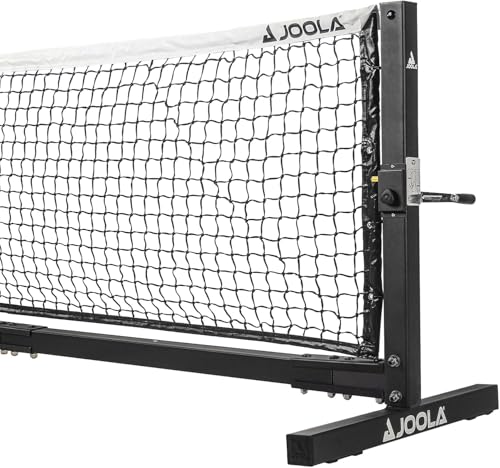
OFFICIAL PADDLE SPONSOR OF WORLD #1 PICKLEBALL PLAYER BEN JOHNS & THE PPA TOUR: An innovator & global leader in table tennis for 70+ years, JOOLA teams up with Ben Johns to create a new line of pickleball equipment that will forever change the game

❗️【PRE-PURCHASE REMINDER TO AVOID WRONG ORDER】This tennis machine is solid black. It shares identical shell & hopper lid with our pickleball model, distinguished only by body print: TENNIS vs PICKLE. Check logo before checkout to avoid wrong orders.

KETT-TEC6 Absolutely Weatherproof Outdoor Top
Scoring in Tiebreakers
Frequently, scoring in tiebreakers presents a crucial turning point in a tennis match. In such high-stakes situations, players must utilize effective tiebreaker strategies. The first player to reach seven points, with at least a two-point lead, wins the tiebreak and subsequently the set. In a scenario where the score reaches 6-6, the action intensifies, continuing until a two-point advantage is secured. Unlike traditional scoring, points in tiebreakers are simply counted as 1, 2, 3, and so forth. Additionally, scoring variations in different tournaments add a unique layer to the game. For example, some events use a super tiebreaker format, while others may apply extended tiebreakers in the final set, enhancing the competition’s excitement. Professional matches often require USTA approved balls to ensure consistent bounce and performance during these critical tiebreaker moments.
Recommended Products

USTA and ITF approved for tournament and league play.

【SPECIFICATION】Diameter: 2.58 Inches; Bounce Height: About 135cm.

72 balls per bucket
Match Structure and Scoring
Match structure and scoring in tennis are fundamental aspects that dictate the flow and outcome of a match. The game consists of points, games, sets, and matches. Players must win four points to secure a game, with specific scoring rules for deuce and advantage scenarios. A set is won by the first player to reach six games, often requiring a two-game margin. Some match formats, like the best-of-three sets or best-of-five sets, influence overall match dynamics and stamina. Tiebreakers typically resolve sets tied at 6-6, but certain scoring exceptions exist, particularly in final sets of Grand Slam events. Understanding these structures will enhance your appreciation and strategy during play and viewing.
Winning a Tennis Match
Winning a tennis match requires more than just skill and determination; it involves mastering the structure of sets and games. In competitive play, one must win a majority of sets, typically two out of three or three out of five. Strategies are vital, as players develop tactics to exploit opponents’ weaknesses, adjusting to match conditions. Player psychology also plays a significant role, impacting focus and resilience during critical moments, such as tiebreaks at 6–6 in a set. Physical endurance must be maintained throughout, especially in longer matches. Understanding the rules guarantees no premature conclusions, as each match is determined solely by the sets won. Consequently, careful preparation and mental fortitude are essential for victory on the court.
Recent Changes in Scoring Rules
The landscape of tennis scoring has undergone notable transformations in recent years, shaped by evolving competition formats and player feedback. A significant recent rule change for NCAA Division III dual matches will take effect in 2026–26, adopting a 7-point team format. Teams will now need 4 points for victory, which integrates the results of 2 out of 3 doubles matches and individual singles matches. In Grand Slams, a final-set standardization has introduced a 10-point tiebreak at 6–6, promoting uniformity across major tournaments. Additionally, mixed doubles at the US Open will see shortened sets and increased prize money. These updates reflect the ongoing scoring evolution in tennis, aiming to enhance player experience while maintaining tradition.
Recommended Products


Recommended for indoor use

Convenient Product Package: our digital scoreboard package is designed with your convenience in mind; It includes an electronic scoreboard, 1 remote control with the battery included, and an informative instruction manual; From the moment you unbox, you'll have everything you need for a seamless setup and use
Overview of Tennis Governing Bodies
Tennis operates under the guidance of several key governing bodies, each playing an essential role in the sport’s global framework. The International Tennis Federation (ITF) oversees worldwide competitions, including the Davis Cup. The Association of Tennis Professionals (ATP) manages men’s professional tours, while the Women’s Tennis Association (WTA) governs women’s events. Regional organizations like Tennis Europe and the Lawn Tennis Association (LTA) support local development and competitions. Various national tennis federations, such as the U.S. Tennis Association (USTA) and the French Tennis Federation, further contribute to the sport’s structure. Importantly, Grand Slam tournaments, including the Australian Open and Wimbledon, exemplify the pinnacle of tennis within this complex system of governing bodies and tennis federations.
Frequently Asked Questions
Can Players Challenge Points During a Match?
Players can challenge points during a match through line challenges, utilizing official reviews to assess disputed calls. Each player typically has three opportunities per set, allowing for the potential correction of incorrect officiating decisions.
What Happens if It Rains During a Match?
When it rains during a match, play is suspended due to unsafe conditions. Organizers then manage rain delays, potentially leading to match rescheduling for the earliest opportunity, ensuring that matches proceed as soon as possible.
Are There Different Scoring Formats in Other Tennis Events?
Yes, there are different formats and scoring variations across tennis events, including traditional sets, pro sets, and modified youth formats. Various tournaments may adopt unique scoring systems to accommodate time constraints and enhance player participation.
How Is a Player’s Ranking Determined?
In the grand theater of tennis, a player’s ranking emerges from a delicate balance of performance, weaving through various tournaments. Ranking points accumulate, reflecting skill and tenacity, shaping the athlete’s position among the elite.
What Equipment Is Necessary to Play Tennis?
Essential equipment for tennis includes appropriate racquets, suited to player skill and court surfaces, alongside proper tennis balls, apparel, footwear for support, hydration gear, and accessories like vibration dampeners and overgrips for enhanced performance.


