As an Amazon Associate, we earn from qualifying purchases. Some links on this site are affiliate links at no extra cost to you. Our recommendations are based on thorough research and editorial judgment.


How Altitude Affects Tennis Ball Flight

At higher altitudes, thinner air creates less resistance, causing tennis balls to fly faster and bounce higher. Players in elevated locations like Denver experience balls traveling up to 10% faster than at sea level. This occurs because reduced air density decreases drag force on the spinning ball. The Magnus effect, which creates curved trajectories, is also diminished at altitude. Professional players must adjust their technique, using heavier topspin and modified swing speeds to compensate. Understanding these aerodynamic principles helps athletes adapt their game strategy when competing at different elevations.
# How Altitude Affects Tennis Ball Flight
Altitude markedly affects tennis ball flight, primarily due to reduced air density. At higher elevations, balls travel 5-10% faster and bounce up to 3 inches higher than at sea level. This increased speed leads to less time to impart spin on shots, complicating trajectory control. Additionally, high altitude tennis balls are designed with lower pressure to manage bounce. You may need to adjust your equipment and strategy for ideal performance, as these factors can greatly influence your game. More insights await you.
Key Takeaways
- At higher altitudes, reduced air density decreases drag on tennis balls, allowing them to travel faster and farther.
- Lower air pressure causes tennis balls to expand, resulting in higher bounces compared to sea level.
- High-altitude tennis balls are designed with lower internal pressure to prevent excessive bounce, maintaining consistent performance.
- Spin effectiveness diminishes at altitude as reduced air density lessens aerodynamic forces, impacting shot control.
- Players must adapt strategies, such as increasing string tension and modifying stroke techniques for optimized performance at higher elevations.
Understanding Air Density at High Altitude
As players step onto high-altitude tennis courts, they immediately notice how air density affects their game. At higher elevations, air pressure drops considerably, leading to density changes that can impact ball behavior. With fewer air molecules present, tennis balls experience less resistance. This means the ball travels faster and farther than at sea level. In addition, temperature also plays an essential role; hot days exacerbate these effects. For instance, in conditions approaching 30°C, you might contend with air density typical of even higher altitudes. Players should adjust their strategies accordingly, recognizing these dynamics. Environmental factors like climate and altitude also influence performance and bounce consistency, requiring careful consideration when selecting equipment for competitive play. Overall, understanding air density at high altitude is vital for optimizing performance in tennis, ensuring you adapt your game effectively to these unique conditions.
The Impact of Reduced Drag Force
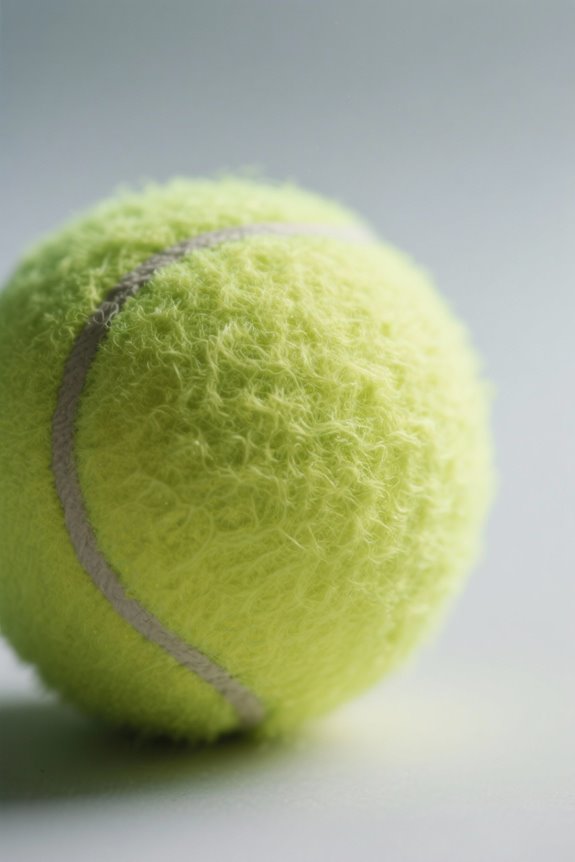
High-altitude play introduces significant alterations to how a tennis ball behaves in flight, particularly due to the reduced drag force effects. At elevations of around a mile, air density decreases by nearly 20%, which directly lowers drag force acting on the ball. Consequently, this drag reduction allows the ball to maintain its velocity longer, travel faster, and cover greater distances compared to sea level conditions. Players experiencing these changes may notice ball speeds increase by 5-10% for the same stroke power. With less aerodynamic resistance, timing and control become essential. The reduction in drag force ultimately reshapes match strategies, as the trajectory and speed of serves and groundstrokes take on newfound sharpness, demanding heightened precision. Professional players practicing at altitude should ensure their tennis net setup meets official specifications to accurately simulate match conditions and adjust to the altered ball dynamics.
How Altitude Influences Tennis Ball Bounce
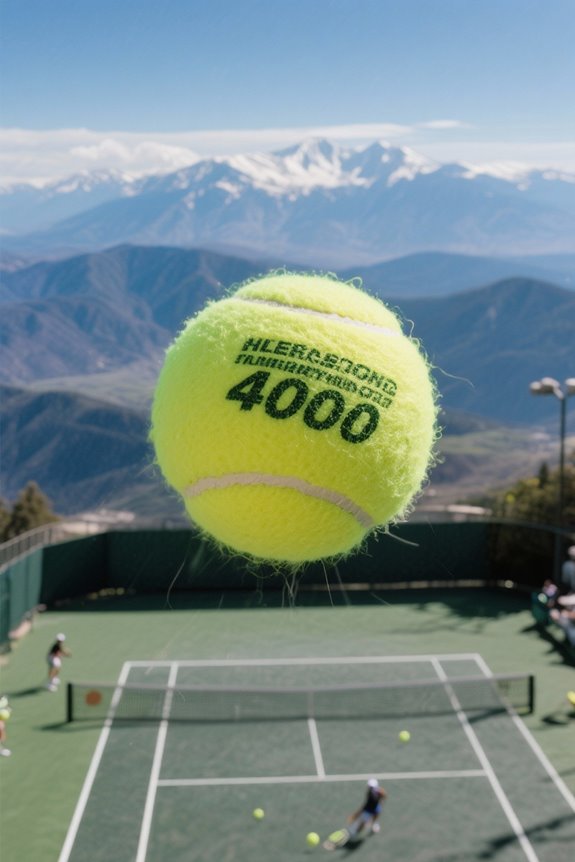
Altitude greatly influences how a tennis ball bounces, presenting both challenges and opportunities for players. At higher altitudes, reduced air pressure causes the balls to expand and stiffen, enhancing bounce mechanics. Stiffer balls retain more elastic energy, resulting in a bounce height of about 53 to 58 inches when dropped from 100 inches, compared to only 48 to 53 inches at sea level. Meanwhile, cooler temperatures can reduce ball elasticity, complicating the altitude effects. The type of court surface also plays a vital role; harder surfaces amplify bounce height, while softer ones may dampen it. Players competing at elevated locations should use high altitude variants specifically designed with adjusted internal pressure to compensate for these atmospheric conditions. As a result, players must adapt their timing and positioning strategies to navigate these altitude-driven changes effectively during matches.
Characteristics of High Altitude Tennis Balls
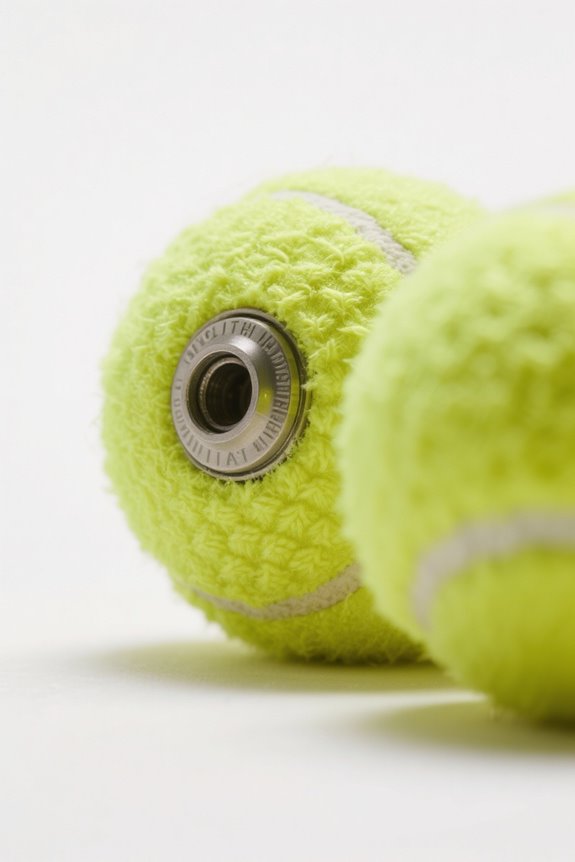
The characteristics of high altitude tennis balls considerably differ from their sea-level counterparts, making understanding these distinctions crucial for competitive players. High altitude considerations dictate that these balls possess lower internal pressure, reducing excessive bounce and speed caused by thinner air. This modification guarantees a familiar play experience for users accustomed to sea-level conditions. Additionally, the core composition is tailored to maintain elasticity without compromising shape, essential for consistent ball response. The felt covering is often treated for durability, optimizing performance in lower pressure environments. Overall, high altitude tennis balls are engineered for stable ball flight dynamics, allowing players to maintain competitive levels, even at elevations around 4,000 feet and beyond, guaranteeing enhanced control and predictability during gameplay. Leading brands like Penn and Wilson construct these specialized balls with multi-layer rubber and interlocked wool fiber to enhance durability and maintain consistent performance at elevations above 3,500 feet.
Recommended Products

✅ 【Precision Craftsmanship for Unmatched Performance 】 Our GCA Pro ball is a testament to precision craftsmanship and dedication to quality. Each ball is meticulously engineered to deliver unparalleled performance in bounce consistency, flight accuracy, and durability. Elevate your game with equipment that exceeds expectations and stands up to intense matches.

USTA and ITF approved for tournament and league play.

Pack of 24 tubes of 3 balls
Temperature Effects on Ball Behavior
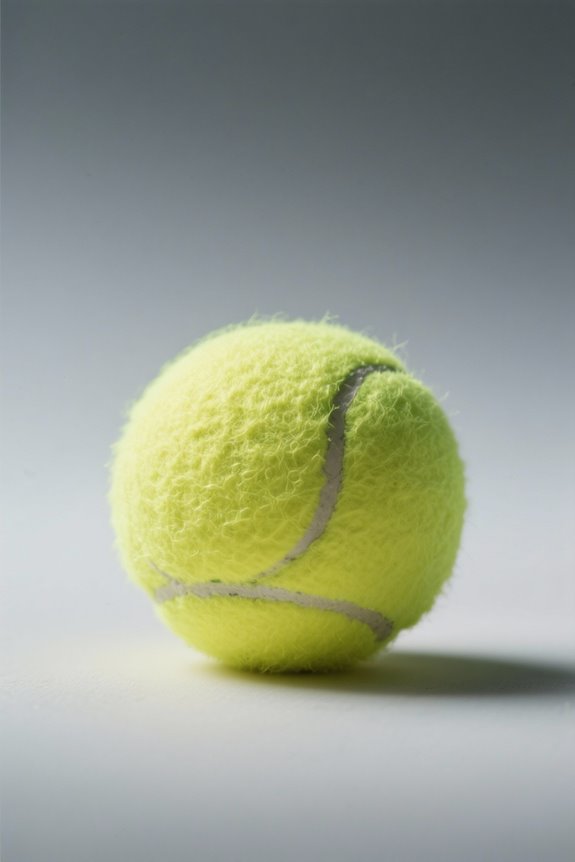
When considering how temperature influences tennis ball behavior, it’s essential to understand that warmer conditions modify the internal dynamics of the ball considerably. Temperature induced elasticity increases as the internal gas pressure rises, resulting in a more responsive ball. This means hotter balls bounce higher and travel faster, enhancing the restoring force in the rubber core. In contrast, colder temperatures decrease bounce resilience, making balls feel slow and flat. Tests show that balls at 50°F bounce markedly higher than those at 2°F. In addition, decreased air density in hotter environments reduces drag, allowing the ball to fly faster. Consequently, players should adapt their strategies according to the temperature, ensuring peak performance on the court. Understanding these temperature effects is particularly important when selecting equipment, as string tension maintenance can also be affected by thermal conditions and impact overall playability.
The Coefficient of Restitution Explained
Understanding the coefficient of restitution (COR) is essential for players and coaches looking to enhance their tennis performance. The COR is a measure of how elastic collisions are, defined as the ratio between the velocities before and after impact. In tennis, it influences how much a ball bounces. Values typically range from 0 to 1, with most tennis balls operating within this spectrum. Accurate COR measurement involves dropping the ball from a standard height and calculating the rebound ratio. Higher COR values equate to better bounciness, impacting gameplay strategies and shot predictions. Furthermore, COR implications extend beyond mere numbers; they can dictate how a player might modify their approach based on different environmental conditions. Quality tennis balls with USTA and ITF approval are designed to maintain consistent COR values, ensuring reliable bounce characteristics during competitive play.
Analyzing the Magnus Effect at Altitude
Altitude plays a considerable role in the Magnus effect, particularly for tennis players aiming to master their spin techniques. As altitude increases, air density decreases, which directly impacts the spin trajectory of tennis balls. With fewer air molecules interacting with the ball, the Magnus force is reduced, leading to diminished lift and altering expected flight paths. For instance, topspin shots may not dip as quickly, causing them to land deeper than anticipated. Backspin shots may float less, limiting their range extension. These altitude challenges require players to adjust their techniques, as the usual effectiveness of spins becomes less reliable. Understanding these factors can considerably improve player performance in high-altitude environments, making mastery of spin all the more essential. Similar to how textured surface technology enhances spin control in pickleball paddles, tennis players must rely on their racquet’s surface characteristics and adjusted stroke mechanics to compensate for the reduced Magnus effect at elevation.
Spin Dynamics and Altitude Changes
As players take to the court in high-altitude conditions, the dynamics of spin become measurably altered. Reduced air density greatly decreases spin effectiveness, impacting how a ball behaves during flight. With lighter air, the aerodynamic forces generated by spin are minimized, leading to diminished curvature and less predictable bounces. For those accustomed to topspin, the ball will drop less sharply, complicating trajectory control. Additionally, faster ball speeds reduce the time for imparting spin, amplifying altitude challenges. Players may struggle to maintain spin rates and need to adjust their techniques, focusing on flatter shots for better accuracy. The choice of equipment becomes crucial in these conditions, as racquets with a 16×19 string pattern can help maximize spin potential even when atmospheric conditions work against traditional spin generation. Consequently, mastering spin in high-altitude play demands not only skill but also adaptability to these unique environmental factors.
Energy Loss Upon Impact Defined
When a tennis ball strikes the court or a racquet, significant energy loss occurs, fundamentally shaping its performance. The ball loses approximately 45-47% of energy during deformation due to impact mechanics. This energy absorption primarily involves hysteresis within the rubber, where internal friction transforms kinetic energy into heat. Additionally, sound energy is generated, representing another layer of energy dissipation. Remarkably, the coefficient of restitution (COR) for tennis balls often hovers around 0.75, indicating a 56% energy return upon rebound. However, at higher impact speeds, energy loss increases as deformation magnifies. Understanding these mechanics is crucial for players seeking peak performance from their equipment while adapting to varying conditions on the court. The tension stability of strings also plays a vital role in energy transfer, as high-quality strings maintain their properties better to ensure consistent performance during play.
Adjustments in Ball Stiffness at Higher Elevations
At higher elevations, nuanced adjustments in ball stiffness become vital for ideal tennis performance. The altitude effects lead to expanded internal pressure, causing standard tennis balls to become excessively bouncy. To counter this, manufacturers create high-altitude balls with a harder and heavier inner core. This adjustment helps maintain consistent overall play by counteracting the unruly bounce. Additionally, these balls typically measure 6% larger in diameter, increasing air resistance and slowing their flight speed. Players often need to adapt their gameplay and consider string tension. With increased ball stiffness, managing shot control becomes more significant, emphasizing the importance of tailoring equipment and techniques to guarantee effective play in high-altitude conditions. Similar to how grip size affects comfort and performance in pickleball, proper equipment selection at altitude can significantly reduce hand fatigue and improve shot accuracy.
Variations in Bounce Heights at Different Altitudes
Variations in bounce heights can greatly influence gameplay, especially at different altitudes. At elevations around 4,000 feet, standard tennis balls can bounce approximately 3 inches higher than at sea level, primarily due to lower air density. This altitude comparison highlights how reduced aerodynamic drag allows the ball to maintain more speed during both flight and rebound. Consequently, players experience quicker ball rebounds, demanding greater control and adjusted strategies. Furthermore, cooler temperatures and different court surfaces further affect bounce dynamics, amplifying these altitude effects. Players accustomed to sea-level conditions may struggle with the increased bounce height, requiring adaptations in their game to effectively manage faster balls and maintain consistent play at high altitudes.
Importance of Equipment Adjustments for High Altitude
As players step onto high-altitude courts, the importance of equipment adjustments becomes clear. Thinner air causes tennis balls to travel faster, which can disrupt timing and control. Increasing string tension can help regain control, but too much stiffness may lead to player discomfort or injury. Softer strings are preferable, as they maintain responsiveness even under higher tension. Regular equipment maintenance is essential; higher tensions can accelerate wear on both strings and rackets, affecting performance. Additionally, racket stiffness must be considered, as it impacts shot feel and control. Players should test different setups before competing at altitude to guarantee peak performance, enhancing player comfort while adapting to the unique challenges of high-altitude play.
Training for Optimal Performance in Thinner Air
Training effectively in thinner air presents unique challenges and opportunities for tennis players. Mental preparation is vital; players must adapt to faster-paced rallies and enhanced ball speed. Training adjustments should focus on moderating intensity initially, as high altitude can lead to fatigue. Players can utilize recovery techniques such as proper hydration and nutrition, which are fundamental in managing physiological stress. Emphasizing ball control becomes paramount; forehands and serves require precision due to altered bounce trajectories. Practicing with high-altitude specific balls can improve familiarity with conditions faced during matches. Additionally, anticipating variable weather at altitude helps refine tactical play. These focused approaches guarantee athletes optimize performance while maneuvering the complexities of thinner air effortlessly.
Recommended Products

【SPECIFICATION】Diameter: 2.58 Inches; Bounce Height: About 135cm.
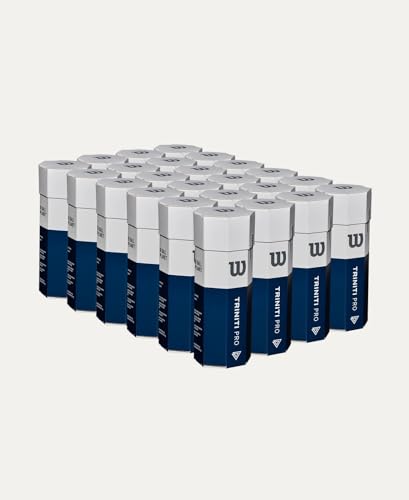
Wilson Triniti Pro Tennis Balls - 72 Balls, Yellow

Approved by ITF for competitive play, Official Ball of Roland-Garros from 2020
The Role of Technology in Adapting to Altitude
Adjusting to the challenges of high altitude requires more than just physical training; technology plays a pivotal role in enhancing performance. Advanced technology integration focuses on adapting tennis balls for thinner air, ensuring ideal player adaptation. High altitude balls, designed with lower internal pressure and slightly larger diameters, help regulate bounce and maintain control. These modifications, supported by rigorous ITF standards, allow players to experience consistent performance despite altitude conditions. Additionally, sophisticated software simulates ball trajectories, aiding athletes in predicting behavior during matches. Manufacturers utilize innovative materials to balance durability and aerodynamics, enhancing dynamics for high altitude play. Overall, these technological advancements equip players with the tools necessary to excel in challenging environments, marrying science with athleticism seamlessly.
Recommended Products

DUNLOP GRAND PRIX REGULAR DUTY TENNIS BALLS: The Dunlop Grand Prix Regular Duty Tennis Balls provide consistent performance for tournament-style play on any surface.

DUNLOP ATP EXTRA DUTY TENNIS BALLS: The official ball of the ATP World Tour, Dunlop ATP Extra Duty Tennis Balls are a great choice for competitive players on hard courts.

Comparing Game Strategies at Sea Level vs. High Altitude
When considering the differences in game strategies, players must adapt considerably to the varying conditions at sea level and high altitude. At high altitudes, reduced air density provides altitude advantages, allowing tennis balls to travel faster and bounce higher. This phenomenon demands game adaptations, particularly in serving and groundstrokes. Players should prioritize placement and spin over raw power, as the faster ball speeds can neutralize aggressive serves. Additionally, aggressive baseliners who favor flat groundstrokes often excel in high-altitude tournaments. Conversely, sea-level players may initially struggle with timing and positioning. Physical endurance becomes critical, as the decreased oxygen levels accelerate fatigue. Therefore, understanding these strategic differences is essential for achieving success across different altitudes.
Recommended Products

Wilson RF 01 Pro Strung Performance Tennis Racket - Grip Size 4-4 1/2", Strung with Sensation 16 Natural at Mid Range Tension

Wilson RF 01 Strung Performance Tennis Racket - Grip Size 3-4 3/8", Strung with Sensation 16 Natural at Mid Range Tension

Wilson RF 01 Future Strung Performance Tennis Racket - Grip Size 2-4 1/4", Strung with Sensation 16 Natural at Mid Range Tension
Frequently Asked Questions
How Does Altitude Affect a Player’s Stamina During Matches?
Like a car running on empty, a player’s stamina management deteriorates at high altitude due to reduced oxygen availability. This depletion leads to quicker fatigue, requiring strategic adjustments and longer recovery times during matches.
What Are the Differences in Court Surface Performance at Altitude?
Court surface performance at altitude differs significantly, with increased court speed and reduced spin effect on hard and clay surfaces, while grass courts become faster but exhibit irregular bounces, demanding quicker player reactions and adjustments.
Do Altitude Effects Vary by Tennis Ball Brand?
Altitude effects do vary by tennis ball brand. Differences in ball composition, such as core density and felt texture, markedly influence brand performance, affecting speed, bounce, and control during play in high-altitude environments.
How Can Players Minimize Injuries at High Altitudes?
Players can minimize injuries at high altitudes by adhering to injury prevention strategies, including thorough warm-up routines. These warm-ups enhance blood flow and flexibility, ultimately reducing the risk of strains and sprains during play.
Are There Altitude-Specific Tactics for Doubles Play?
Altitude-specific tactics for doubles play involve emphasizing quick team communication, coordinating movements, and utilizing aggressive net strategies. Adjusting shot placement and incorporating spin enhances control, while synchronized lateral movement increases court coverage efficiency, adapting to altitude conditions.