As an Amazon Associate, we earn from qualifying purchases. Some links on this site are affiliate links at no extra cost to you. Our recommendations are based on thorough research and editorial judgment.


Playing Pickleball at Night: Lighting Considerations

Elevate your nighttime pickleball game with proper illumination. Professional-grade LED court lighting systems ensure optimal visibility, featuring adjustable brightness levels and anti-glare technology. Premium portable light towers provide 360-degree coverage, while weatherproof construction guarantees durability. Essential accessories include high-visibility paddles with reflective trim, glow-in-the-dark balls, and rechargeable battery packs. Strategic placement eliminates shadows and dead zones, creating uniform light distribution across the court. Includes mounting hardware, remote controls, and energy-efficient fixtures rated for extended play sessions. Transform any outdoor court into a premium nighttime playing venue with tournament-quality lighting solutions.
# Playing Pickleball at Night: Lighting Considerations
Playing pickleball at night requires careful lighting considerations for safety and visibility. Courts should have a minimum illumination of 300 lux, with LED fixtures preferred for efficiency. Mount lights at least 20 feet high to minimize glare and guarantee even light distribution. Costs for installation can range from $8,000 to $20,000 per court, depending on materials. Proper lighting enhances player experience, so it’s essential to choose quality fixtures that meet recognized standards. Discover more on optimizing your court setup for night play.
Key Takeaways
- Ensure adequate illumination of at least 300 lux horizontally for recreational play to improve visibility and safety during night games.
- Utilize LED lighting for its longevity and energy efficiency, providing clear visibility and better color distinction essential for tracking fast-moving balls.
- Aim for a color temperature between 4000K and 5000K to enhance clarity and reduce glare on the court surfaces and nets.
- Maintain uniform light distribution to prevent dark spots and glare, promoting better focus and reducing accident risks among players.
- Regular maintenance of lighting fixtures and court equipment is crucial for safety and optimal performance during nighttime matches.
Understanding Pickleball Court Dimensions
Understanding the dimensions of a pickleball court is vital for both players and facility operators. A standard court measures 20 feet wide by 44 feet long, accommodating both singles and doubles play. These dimensions align with those of a doubles badminton court, providing familiar ground for some players. Each court features distinct line markings, essential for defining areas like the Non-Volley Zone, which extends 7 feet from the net. The court’s service areas are divided by a centerline and have specific measurements to meet official regulations. With at least 5 feet of side clearance and 8 feet at the ends recommended, these specifications guarantee a safe playing environment. For night play, brightly colored balls similar to those used in tennis can enhance visibility and help players track the ball more effectively under artificial lighting. Accurate court dimensions and line markings enhance overall play quality and enjoyment.
Importance of Proper Lighting Levels

Proper lighting levels on a pickleball court greatly enhance the playing experience. Adequate illumination notably improves night visibility, allowing players to see court lines, nets, and fast-moving balls. This reduces the risk of accidents, such as trips and collisions, by ensuring proper lighting effectiveness. Studies show that higher light levels, ranging from 30 to 75 footcandles, correlate with better reaction times and lower injury rates. Uniform light distribution also prevents glare and dark spots, helping players maintain focus. A high color rendering index improves color distinction, aiding performance during critical plays. Furthermore, ideal lighting benefits spectators, enhancing their viewing experience by providing clear sightlines and reducing visual fatigue. Clear visibility of the ball is especially important given that premium paddles with carbon fiber surfaces can generate significant spin, making ball tracking crucial for successful returns. Proper lighting truly enriches every aspect of the game.
Recommended Products
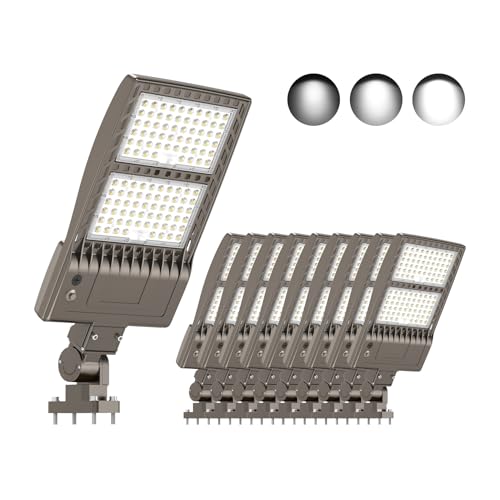
[ Commercial Grade & 5 Years Service ] Super bright 450W led parking lot light with 67,500Lm, 5000K daylight white, TYPEⅢ beam angle, no glare, no strobe light, best area coverage for outdoor area lighting. 5-year replacement service for any defects or quality issues

[ Commercial Grade & 5 Years Service ] Super bright 450W led parking lot light with 67,500Lm, 5000K daylight white, TYPEⅢ beam angle, no glare, no strobe light, best area coverage for outdoor area lighting. 5-year replacement service for any defects or quality issues

85% Energy Saving 💡The 600 watt LED stadium light adopt premium SMD and high efficiency optical lens, each lights provide up to 90000 lumens in 5000K bright light, easliy replace 2400W HPS/HM, which save over 85% electricity bill at least.
Lighting Standards for Different Competition Classes

Lighting standards for pickleball courts play a vital role in enhancing the game, particularly during night matches. Competitions are divided into three classes, each with specific competition class requirements. For Class I (Professional), a minimum of 750 lux horizontal illumination and 450 lux vertical illumination is essential. Class II (Club/Competition) standards recommend 500 lux horizontally and 350 lux vertically. For recreational play, Class III calls for 300 lux horizontal and 200 lux vertical illumination. An illumination standards comparison reveals that uniformity and color temperature also differ, with professional matches requiring more stringent criteria. Proper lighting not only improves visibility but guarantees a safe and enjoyable experience for all players, regardless of skill level. Professional players often benefit from having thermal insulated compartments in their bags to protect sensitive equipment when traveling between well-lit facilities for tournament play.
Recommended Products

Excellent Performance - Featuring high quality 5050 LED Chips and epoxy coating poly-carbonate prismatic lens with an high efficiency of up to 150 lumens per watt, Sokply 650W stadium lights produce up to 97,500 lumens with a beam Angle of 60 degrees and are designed to replace the 2,600 watt metal halide stadium lights. The 5000K color temperature ensures bright and clear white light and allows for high standards of photo and video capture production.

✔3 Wattage Light Modes -- Our outdoor flood lights feature three power modes: 320W (48,000 lumens), 256W (38,400 lumens), and 192W (28,800 lumens). Simply adjust the sliding switch to your desired setting before installation. This flexibility allows you to efficiently illuminate any space while achieving up to 90% energy savings compared to traditional metal halide lights

Light up A Larger Area: The 90° beam angle concentrates light where you need it.From 40ft high, your entire parking lot is evenly lit. Perfect for sports, security, and large areas where shadows hide trouble
Technical Specifications for Ideal Lighting Fixtures
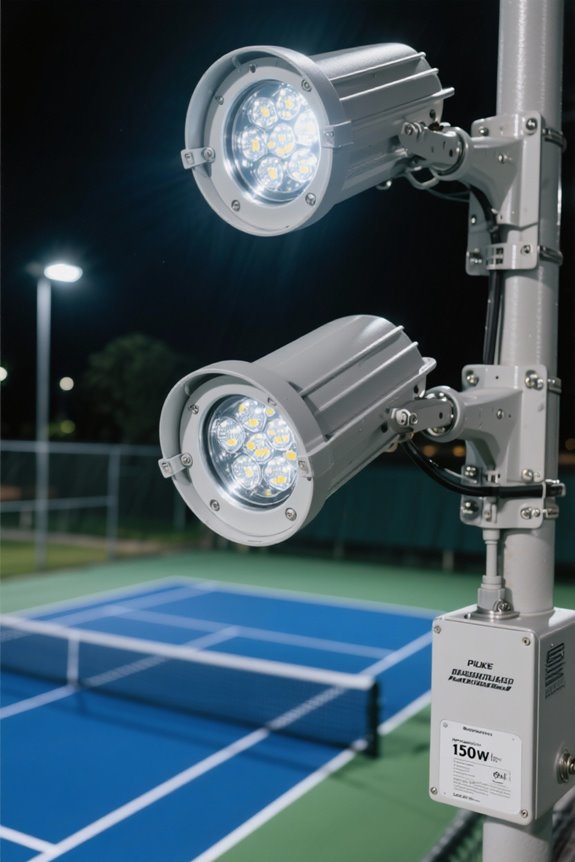
When selecting lighting fixtures for pickleball courts, several key technical specifications should be kept in mind to secure maximum performance. Illumination levels should maintain an average of 300 lux for recreational play, with a color temperature between 4000K and 5000K for ideal visibility. A Color Rendering Index (CRI) above 70 enhances color accuracy. Fixtures must be mounted on poles at least 20 feet high to prevent ball disappearance, maintaining fixture efficiency. The optics should allow for adjustable beam angles and minimize glare. Additionally, a maximum uniformity ratio of 2.0 guarantees even light distribution. Durability is essential, so opt for fixtures made of weather-resistant materials like die-cast aluminum to withstand various conditions during night play. Similar to how tension adjustments affect performance in tennis equipment, regular monitoring of lighting fixture angles and intensity can help maintain consistent court conditions throughout extended play sessions.
Safety and Visibility in Night Play
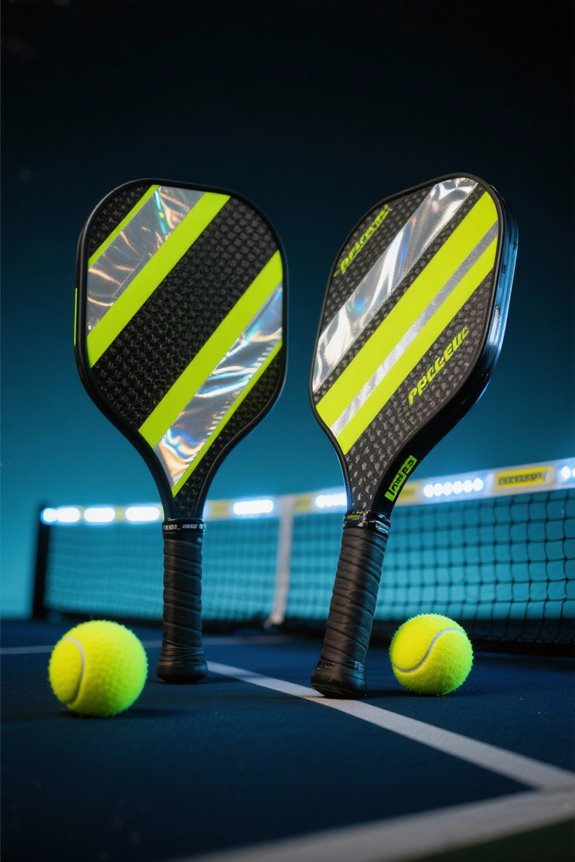
Guaranteeing safety and visibility during night play is essential for an enjoyable pickleball experience. Proper lighting must maintain a minimum average of 30 footcandles, while club and professional settings require 45 and 70 footcandles, respectively. This minimizes glare effects that can impair player reaction times. Effective shadow management involves mounting fixtures around 20 feet high to prevent shadows from players and net structures. Additionally, overlapping light coverage reduces dark spots, enhancing depth perception. For visual clarity, choose lights with a CRI above 70 and a correlated color temperature (CCT) between 4000K and 5000K. This guarantees accurate color rendering and minimizes eye strain, allowing players to focus. When multiple courts are illuminated simultaneously, maintain a distance of 8-10 feet between playing areas to prevent light interference and support coordinated play. Ultimately, proper lighting enhances safety and guarantees a balanced playing experience.
Cost and Installation Considerations
Setting up a pickleball court for night play involves careful planning and budgeting. Installation budgets vary considerably, typically ranging from $17,200 to $122,000 for complete setups. For new installations, costs generally fall between $8,000 and $20,000 per court, while retrofits are more economical. Cost factors affecting overall expenses include the quality of LED fixtures, lighting requirements, and local labor prices. Key components consist of galvanized steel poles, precast concrete bases, and advanced control systems, with pole installation ranging from $4,800 to $27,000. Although initial costs may seem high, investing in LED lighting can yield substantial energy savings, reducing your long-term expenses and maintenance requirements considerably compared to traditional systems. When budgeting for your night play setup, remember to allocate funds for essential equipment like power pickleball paddles, which typically range from mid-range to premium pricing depending on materials such as T700 or T800 carbon fiber construction.
Environmental and Regulatory Compliance
As communities embrace night pickleball, understanding environmental and regulatory compliance becomes essential. Compliance with local regulations is vital to minimize the environmental impact of lighting installations. Municipalities often enforce ordinances that govern light intensity, pole heights, and fixture types, ensuring safety and community aesthetics. For instance, many areas limit pole heights to between 25 and 30 feet and require fully shielded fixtures. Dark Sky compliance, advocated by organizations like the International Dark-Sky Association, promotes using low color temperature lights to decrease skyglow. Additionally, lighting designs must undergo permits and inspections to align with zoning rules. By adhering to these standards, communities can enhance nighttime play while protecting local ecosystems and preserving residential tranquility, ultimately fostering a healthier environment for all. Similar to how tennis facilities maintain optimal conditions through regular maintenance of equipment like string tension to prolong performance, pickleball courts require consistent upkeep of lighting systems to ensure safe and enjoyable play.
The Role of LED Technology in Court Lighting
When it comes to illuminating pickleball courts, LED technology plays a pivotal role in enhancing both visibility and overall playability. One major advantage of LED lights is their energy-efficient nature, cutting electricity costs remarkably compared to traditional lighting. With a typical lifespan exceeding 50,000 hours, LEDs require fewer replacements, ensuring low maintenance expenses. The lighting versatility offered by LEDs allows for customizable color temperatures, with options from 4000K to 5000K for ideal clarity. Sports enthusiasts will also appreciate that high-lumen fixtures reduce shadows, providing even illumination across the court. Additionally, advanced optics minimize glare, improving players’ focus. Just as proper lighting ensures visibility during night play, selecting equipment with durable materials like rust-proof aluminum and tear-resistant nets ensures consistent performance in any playing conditions. Overall, adopting LED technology leads to superior lighting conditions, enhancing the nighttime pickleball experience.
Recommended Products

[ Commercial Grade & 5 Years Service ] Super bright 450W led parking lot light with 67,500Lm, 5000K daylight white, TYPEⅢ beam angle, no glare, no strobe light, best area coverage for outdoor area lighting. 5-year replacement service for any defects or quality issues
[ Commercial Grade & 5 Years Service ] Super bright 400W led parking lot light with 60,000Lm, 5000K daylight white, TYPEⅢ beam angle, no glare, no strobe light, best area coverage for outdoor area lighting. 5-year replacement service for any defects or quality issues

[ Commercial Grade & 5 Years Service ] Super bright 450W led parking lot light with 67,500Lm, 5000K daylight white, TYPEⅢ beam angle, no glare, no strobe light, best area coverage for outdoor area lighting. 5-year replacement service for any defects or quality issues
Maximizing Player Experience Through Effective Lighting
Effective lighting is essential for enhancing the player experience on pickleball courts, ensuring visibility and comfort. Ideal illumination levels range from 30 to 70 footcandles, depending on play type. Uniform lighting, with a maximum to minimum ratio of 2.0 or less, maintains visual clarity and minimizes shadows. Poles should be about 20 feet tall, preventing glare that compromises player comfort. The ideal color temperature falls between 4000K and 5000K, enhancing contrast without straining the eyes. Additionally, using fixtures with a Color Rendering Index above 70 accurately portrays colors, improving players’ judgment. Consistent lighting enhances focus for players and spectators alike, creating an enjoyable environment for all involved in the game. Proper lighting also helps players better track high-visibility colored balls during fast-paced rallies and serves.
Frequently Asked Questions
How Do Weather Conditions Affect Pickleball Court Lighting?
Weather conditions greatly impact court visibility, as moisture and precipitation can diffuse light, leading to glare and reduced illumination. Extreme temperatures may also affect fixture integrity, necessitating ideal lighting solutions to guarantee safety and performance.
What Types of Bulbs Are Best for Outdoor Pickleball Courts?
LED bulbs are ideal for outdoor pickleball courts due to their energy efficiency and long lifespan. Their brightness guarantees maximum visibility, enhancing gameplay while reducing maintenance costs associated with frequent bulb replacements, making them an advantageous lighting solution.
How Can I Maintain My Pickleball Court Lighting?
Regular maintenance schedules enhance energy efficiency, leading to significant cost savings over time. This includes inspecting fixtures, replacing bulbs promptly, cleaning lenses, optimizing control systems, and adjusting lighting for peak court performance.
Are There Noise Regulations Associated With Pickleball Court Lighting Installations?
Yes, noise regulations often accompany court lighting installations, imposing sound restrictions based on residential proximity. These regulations may require noise studies, limit operating hours, and mandate measures like acoustic barriers to mitigate noise impact.
Can I Use Portable Lighting for Temporary Pickleball Court Setups?
Absolutely, portable lighting serves as the ultimate temporary solution for pickleball court setups! With diverse lighting options available, they illuminate the court like a stadium, ensuring visibility and excitement for every exhilarating nighttime match.